Why Pavements Deform Under Traffic: Viscoelastic Creep In Bitumen
Introduction
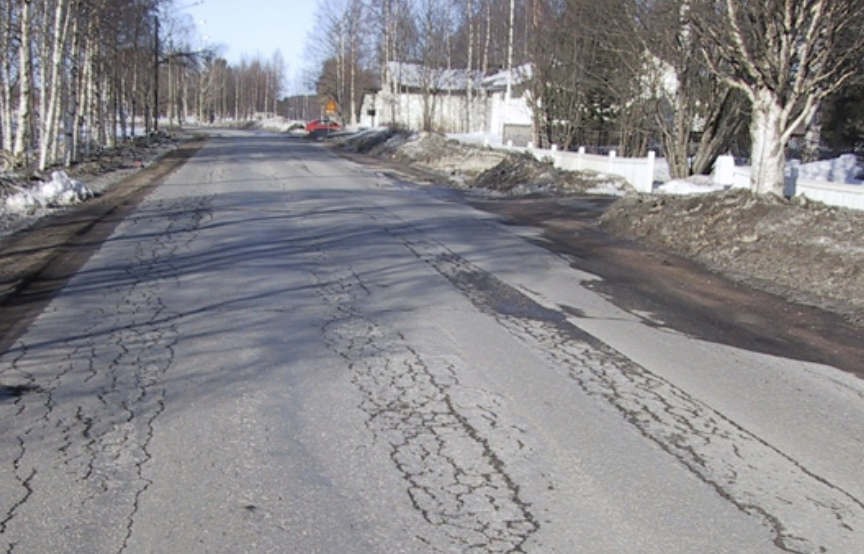
Road pavement defects affect road users, infrastructure managers, and transportation systems and can cause serious risks to safety. Many of these defects appear from the rutting of the surface layer of the pavement, where aggregates with bitumen as a binder fail to withstand repeated vehicle loading. To improve road durability and safety, it is important to understand why pavements deform over time.
What is Bitumen and How is it Produced?
To understand the problem better, it is necessary to define bitumen, what it is, and where it comes from. We start with crude oil. Firstly, crude oil is heated in a fractionating column to separate different hydrocarbon fractions based on their boiling points. Bitumen residue is left at the bottom of the column, as its boiling point exceeds 500 degrees Celsius. Since bitumen is too thick to boil at normal pressures, a vacuum distillation process is used. This reduces the pressure, allowing bitumen to vaporise at lower temperatures and separating heavier oils, leaving purer bitumen.
The Viscoelastic Nature of Bitumen
In classical mechanics, materials are often described as elastic solids or viscous fluids. Elastic materials deform under load and recover their original shape when the load is removed (given that they are still in the region of Hooke’s law), while viscous materials continue to deform as long as stress is applied. These behaviours can be described using physical concepts of stress and strain, where stress is the force applied per unit cross-sectional area, and strain represents the proportion of how much the material has deformed compared to the original shape. In an ideal elastic solid, strain occurs instantaneously and remains constant under a constant stress, fully recovering when the stress is removed. On the contrary, an ideal viscous material shows a gradual increase in strain with time, resulting in permanent deformation. Some materials do not fit entirely into those categories and instead possess both elastic and viscous properties. Bitumen is one of these materials, and it is described as viscoelastic. While this viscoelastic behaviour helps prevent brittle cracking, it also leads to creep and the gradual development of permanent rutting in road pavements.
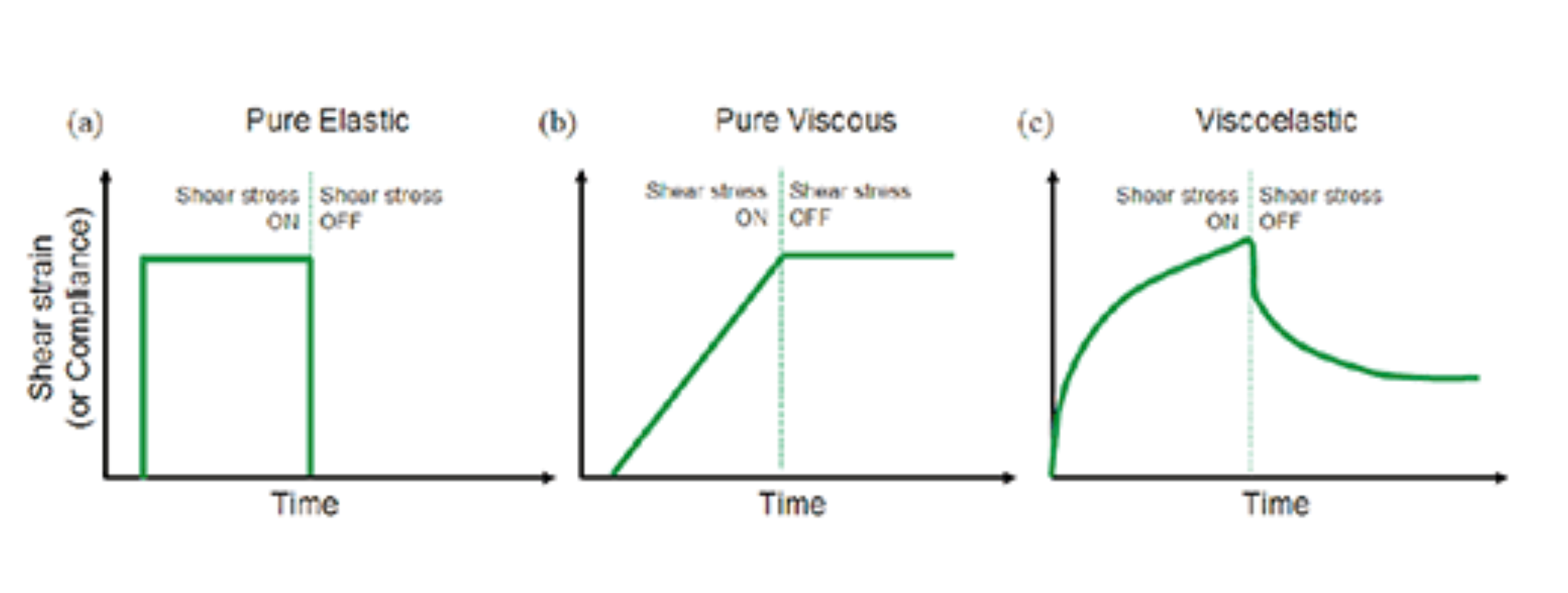
However, in bitumen, deformation depends not only on stress but also on time, temperature, and loading conditions. When a load is applied to bitumen, some deformation occurs instantaneously as elastic strain caused by the stretching of molecular bonds. Simultaneously, viscous components act through the slow movement of large molecules, forcing them to slide over one another and causing permanent deformation. Moreover, bitumen reacts differently depending on the duration of loading and temperature. If stress is applied for a short period of time at low temperatures, bitumen behaves more like a solid, recovering deformation when the stress is removed. However, when stress is applied for a long time at relatively high temperatures, viscous flow becomes more significant, and the material begins to deform permanently with time.
Measuring Bitumen Behaviour: The Dynamic Shear Rheometer
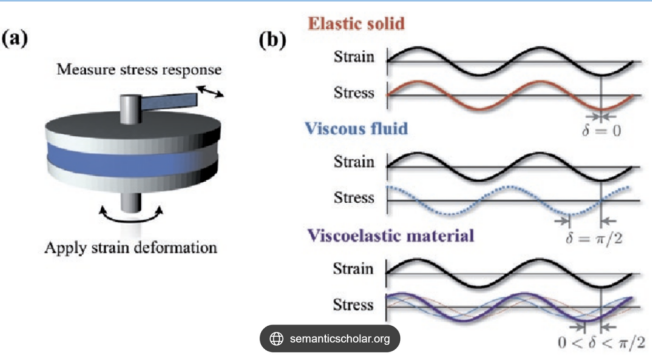
One of the common ways to investigate the rheological behaviour of bitumen is to use a Dynamic Shear Rheometer (DSR). A DSR is a device used to measure how bitumen resists deformation under repeated loading. A thin disc of bitumen is placed between two plates, where the bottom plate is fixed and the top plate rotates back and forth. This applies a small sinusoidal shear strain (strain parallel to the surface of the material). The equation for shear strain at any time point is given by:
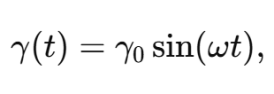
where γ0 is the maximum strain and ω is the angular frequency. As the plate rotates, bitumen resists the strain, and the rheometer measures the torque required to maintain the motion. The torque is then converted to shear stress. The measured stress also varies sinusoidally and is given by:
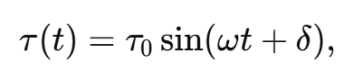
where τ0 is the maximum stress and δ is the phase angle. The phase angle represents the time delay between the applied strain and the resulting stress. For ideal elastic materials, stress is in phase with strain. For ideal viscous materials, stress is π/2 out of phase. However, for viscoelastic materials such as bitumen, the stress lies between 0 and π/2 out of phase with the strain. Additionally, by knowing the maximum stress and strain, the complex shear modulus (G*) can be quantified. This represents the overall stiffness of a bitumen sample and is defined as the ratio of shear stress to shear strain, with a higher value of G* indicates a stiffer material, and vice versa.
Assumptions and Limitations of DSR Testing
As in any laboratory experiment, to ensure valid results, some assumptions have to be made. The applied shear strain is maintained at a low level to keep the material in the linear viscoelastic region, where stress is directly proportional to strain. This assumption ensures that the measured parameters reflect the internal viscoelastic properties of bitumen rather than damage or structural changes. In addition, the load applied during the test is considered ideal sinusoidal, which can provide a controlled approximation of the deformation caused by traffic movement. The test is also conducted under constant temperature conditions, as the viscoelastic properties of bitumen are highly dependent on temperature. Although these assumptions simplify the conditions experienced by real road pavements, they allow for meaningful comparison between different materials.
Creep and Long-Term Pavement Deformation
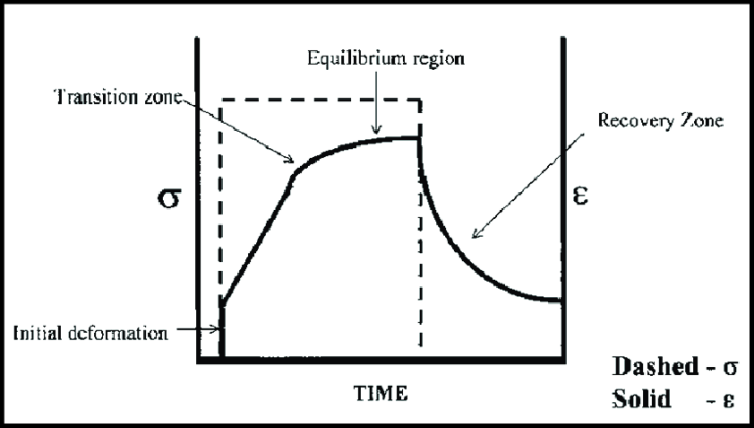
The sinusoidal loading used in DSR captures the immediate viscoelastic response of bitumen; however, the long-term deformation of pavements arises from time-dependent behaviour under stress, known as creep. Creep is the tendency of a solid material to undergo slow deformation while under constant exposure to stress. Unlike brittle cracking, creep deformation does not occur instantaneously. Instead, strain accumulates as a result of long-term exposure to stress, and this process usually occurs at high temperatures. When stress is removed, the deformation produced by creep is only partially recovered. The elastic component returns to its original form immediately, while the viscoelastic component may recover slowly over time. However, the viscous component deforms permanently. Under constant traffic loading, this permanent deformation accumulates, ultimately manifesting as ruts in the asphalt pavement. Each vehicle pass causes a small amount of permanent deformation, and the cumulative effect results in significant depressions in the road surface. This explains why roads do not collapse suddenly but instead gradually deteriorate as a result of time-dependent deformation. Therefore, understanding creep and recovery behaviour is essential for predicting pavement performance and developing asphalt materials that are resistant to permanent deformation under long-term stress.
Bibliography
1. "Road Pavement Layers – Components and Functions." Vin Civilworld, 14 July 2025, vincivilworld.com/2024/07/02/road-pavement-layers-components-functions/#h-road-pavement-layers-and-their-functions.
2. "Just a Moment..." Just a Moment.., sripath.com/improving-rutting-resistance-and-asphalt-pavement-durability/.
3. "Creep (deformation)." Wikipedia, the Free Encyclopedia, Wikimedia Foundation, Inc, 13 Jan. 2026, en.wikipedia.org/wiki/Creep_%28deformation%29. Accessed 22 Feb. 2026.
4. "Viscoelasticity." Wikipedia, the Free Encyclopedia, Wikimedia Foundation, Inc, 7 Dec. 2025, en.wikipedia.org/wiki/Viscoelasticity. Accessed 22 Feb. 2026.
5. "Tensile Testing." Alex's Web Page, alexanderrt.weebly.com/tensile-testing.html.
6. Bitumen, Premium. "How Bitumen is Made: A Step-by-Step Guide to Production and Refining." Premium Bitumen, 5 May 2025, premiumbitumen.com/how-bitumen-is-made-a-step-by-step-guide-to-production-and-refining/.
7. "What is Fractional Distillation?" ReAgent Chemicals, www.chemicals.co.uk/blog/what-is-fractional-distillation.
8. YouTube. (n.d.). [Video on material testing / rheological behaviour] [Video]. https://www.youtube.com/watch?v=JTtfKORhZEU
9. "Dynamic Shear Rheometer." Pavement Interactive – Free Online Knowledge for the Paving Industry, 3 Feb. 2026, pavementinteractive.org/reference-desk/testing/binder-tests/dynamic-shear-rheometer/?utm_source=chatgpt.com.