Can A Building Be Too Strong?

Have you ever wondered if a structure could be built so strong that it creates more problems than it solves? Often the strength of a building is considered its greatest asset; however, engineers must balance power, practicality, and cost-efficiency. Without sufficient strength, buildings would not stand, yet too much strength brings expense, waste, and potential structural issues.
The Limits of Perfect Strength
The first question we must ask is: can we build an object or structure that is perfectly strong? The answer is no. A perfectly rigid structure is an idealised concept in which a body does not compress at all, no matter how much force is applied. In such a structure the distance between any two points would always remain the same, regardless of stress or load. Although the concept is useful for simplifying calculations, all real materials deform under stress, even if only microscopically. This must be true because if a structure were perfectly rigid, disturbances would be transmitted instantly through it — implying information would travel faster than the speed of light, which would violate basic physical laws. Therefore engineers design with controlled flexibility and allow for a safe amount of flex.
The Problems With Overbuilding
While controlled strength is important, making a structure too strong, too large, or too rigid — a practice known as overbuilding — can create many problems. Overbuilding may seem like a sure way to prevent collapse, but physics imposes limits such as the speed of light and maximum material loads. Take the Large Hadron Collider for example: it is the world's largest particle accelerator, designed to recreate conditions like those of the early universe. The collider shows how close humans can push physical limits while still keeping systems energy-efficient enough to operate.
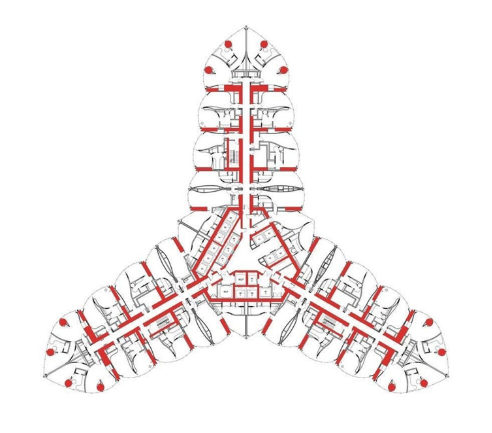
Increasing the size of a building is not as simple as it sounds because of scaling laws. Mass grows with volume while structural strength grows with cross-sectional area; as a result, engineers must make structures proportionally wider for each unit of added height. Not only is strength disproportionate to volume, but energy losses and inefficiencies (from friction, drag, and heat) typically grow as well. Engineers must therefore identify the point where increasing size produces diminishing returns. For example, the Burj Khalifa includes a buttressed core because, as height increases, the mass-to-strength ratio, wind forces, and oscillations all grow disproportionately. There is also always uncertainty in very large or complex designs: as a structure becomes more massive or complicated, it becomes harder to predict interactions such as vibrations, resistance, and thermal expansion.
The Importance of Structural Soundness
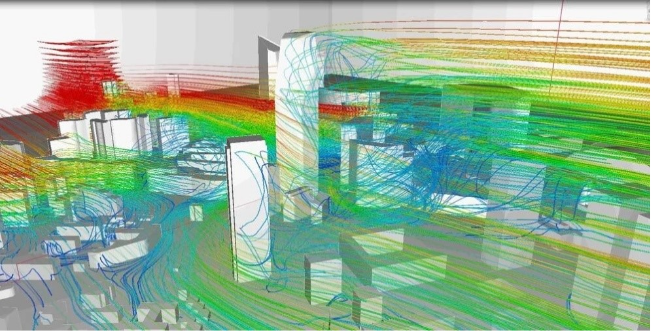
Beyond the upper bounds of how strong a building can be, it is equally important that buildings remain structurally sound. We must avoid under-building as well as over-building. A building must support both its own weight (dead load) and added loads (live load, furniture, occupants). Extreme forces from the environment act on structures in all directions and with varied magnitudes. Structures must be able to dissipate forces so pressure does not concentrate in one spot and cause buckling or collapse. Building codes and standards are in place to prevent dangerously weak designs. Buildings are typically designed with safety factors of about 1.5 to 3 times the maximum predicted load. Paired with modern models and simulations, engineers can design structures that are both safe and efficient.

Balancing Rigidity and Flexibility
While strength is crucial, buildings must balance rigidity with flexibility. Rigidity resists deformation and can make a structure strong but brittle; flexibility lets a structure bend and absorb energy without breaking, which helps dissipate forces. For example, a building cannot be so rigid that it does not deform during an earthquake. In seismic regions, engineers therefore use flexible materials such as steel and reinforced concrete to absorb earthquake energy without snapping. However, excessive movement can cause instability or discomfort for occupants, as seen in swaying skyscrapers — which highlights the central question engineers face: where is the equilibrium point where flexibility and rigidity combine to create the most effective structure?
Deterministic and Probabilistic Design
Once engineers determine the optimal balance between rigidity and flexibility, they must find which parts of the structure experience the greatest stresses. Engineers use both deterministic equations and probabilistic methods to do this. Deterministic equations apply known physical laws and assume no randomness; they give precise outputs for given inputs (for example, basic stress formulas). Probabilistic mechanics accounts for inherent uncertainties — variability in material properties, load magnitudes, or boundary conditions — and typically uses statistics to express outcomes as probabilities rather than unique results. Structural engineers therefore use probabilistic approaches to handle variability in materials like steel and concrete, improving safety and reliability compared with purely deterministic designs.
Conclusion
In conclusion, a building can indeed be too strong. Excessive rigidity or the overuse of materials can yield designs that are inefficient, wasteful, and environmentally costly. Overbuilding to the point of extreme rigidity can even be weaker than a design that allows for controlled flex. True engineering is not about absolute strength, but about finding the optimal balance where strength, efficiency, and safety meet.
Bibliography
"Design Encyclopedia — Entry 469108." Design Encyclopedia, Accessed 13 Mar. 2026.
"Deterministic System." Wikipedia, Accessed 13 Mar. 2026.
"Impact of Overbuilding." Buildings and Cities, Accessed 13 Mar. 2026.
"Importance of Building Stability." Dart and Co, Accessed 13 Mar. 2026.
"The Importance of Structural Engineering in Ensuring Building Safety and Longevity." WAB Designs, Accessed 13 Mar. 2026.
"Is It Correct to Say That It Is Theoretically Impossible for Perfect Rigid Bodies to Exist?" Physics Stack Exchange, Accessed 13 Mar. 2026.
"Probabilistic Engineering Mechanics." ScienceDirect, Elsevier, Accessed 13 Mar. 2026.
"The Problems of Overbuilding." PHP Online, Accessed 13 Mar. 2026.
"Structural Rigidity." Wikipedia, Accessed 13 Mar. 2026.
"What Lies Between Rigidity and Flexibility of Structures." ResearchGate, 2021, Accessed 13 Mar. 2026.