Zeno's Paradox and The Perfect Defence
How Mathematics Designs the Perfect Defence
Introduction
Mathematics is often portrayed as a subject concerned merely with numbers, equations, and artistic problems. However, mathematics can also be used to model how everyday real systems work. One instance of such a mathematical idea is from over 2000 years ago, called Zeno's paradox. Although Zeno originally used his paradoxes to question whether motion was logically possible, modern mathematics provides a solution by means of infinite series summation and limits. The same mathematical ideas can be applied to defence engineering; rather than relying on one singular impenetrable barrier, an effective defence consists of multiple layers, with each layer systematically reducing the threat until it has been completely stopped. In theory, this forms a perfect defence that becomes practically impossible or increasingly difficult to penetrate.
Zeno's Paradox
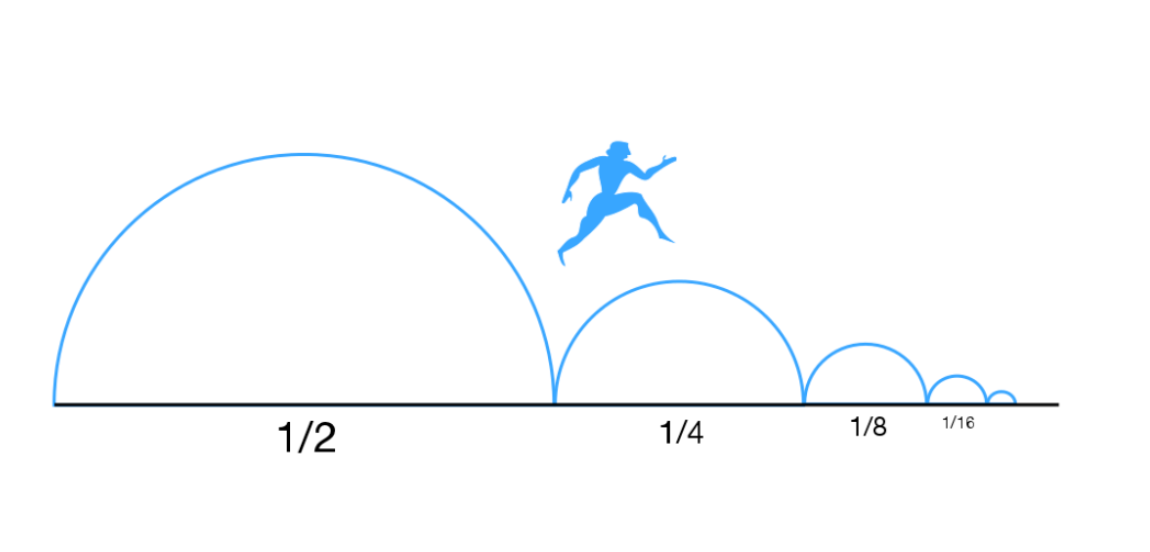
One of Zeno's most notable arguments is the dichotomy paradox, which is closely related to another of his paradoxes: Achilles and the Tortoise. In this story, Achilles, a famous Greek warrior, races against a much slower tortoise, which is given a head start. By the time Achilles reaches the tortoise's starting position, the tortoise has moved slightly further ahead. When Achilles reaches that new position, the tortoise has moved forward again. This process continues infinitely, suggesting that Achilles can never overtake the tortoise, despite being much faster. Similarly, imagine an person travelling towards a certain point. Before reaching that point, the person must first travel half of the original distance to the point, then half of the remaining distance, and so on. Therefore, the sum of distances travelled can be represented by an infinite geometric series:

Upon first glance, Zeno's reasoning seems to suggest that the person will never arrive at the defending point, as there will always be another infinitely smaller distance left to travel between it. However, modern mathematics shows why this conclusion can be deemed incorrect. The expression below is a geometric series, where the common ratio is one half. The formula for the sum of an infinite geometric series is:

where a represents the first term and r is the common ratio. Therefore,

Modelling Defence with Exponential Decay
This proves that although there exist infinitely many mathematical steps, their total distance is finite, emphasising the important mathematical concept of limits. Applying this principle to defence engineering, we are provided with an interesting model for a near-infinite amount of layered defence. Suppose that each defensive layer stops half of the threats that reach it. If 1,000 incoming threats encounter the first layer, 500 pass through. After the second layer, 250 remain, after the third, 125, and so on. Mathematically, after n amount of defensive layers, the expected number remaining of threats remaining can be shown as

where N0 denotes the original number of threats. As n tends to infinity,

The important idea is not that a real defence could contain infinitely many layers, rather, Zeno’s paradox demonstrates how repeated proportional reductions can rapidly make the remaining risk practically without impact. In our example beginning with 1,000 threats, ten layers would leave an value of
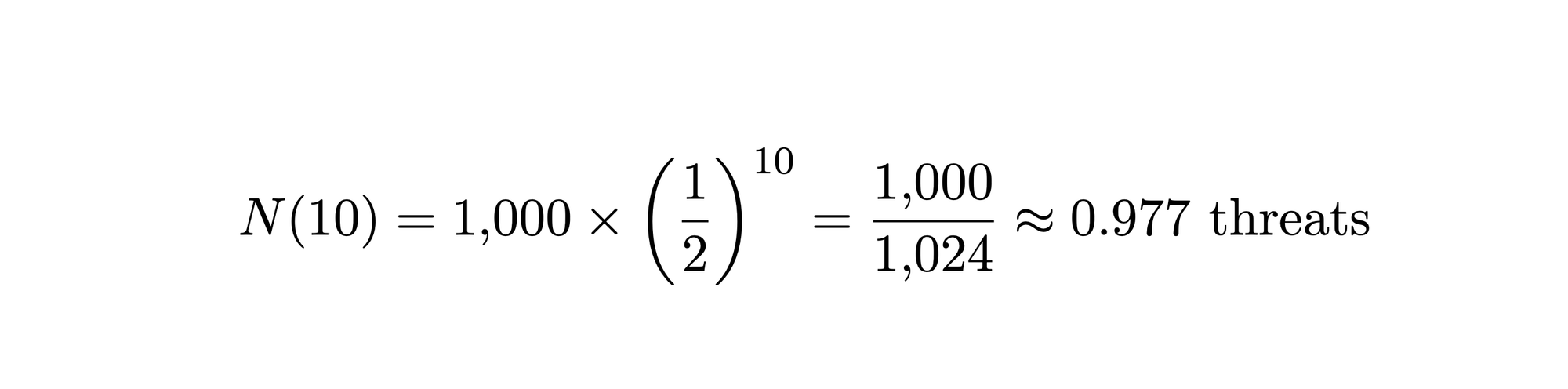
This exemplifies the effect of exponential decay. Adding more layers does not reduce the threat by the same fixed number each time, but repeatedly reduces what remains. In short, mathematics suggests that a strong defence does not necessarily depend upon creating a single barrier made of impenetrable material that is impossible to defeat; multiple imperfect barriers can combine to produce a much stronger overall system.
Reliability and Probabilistic Independence
On the other hand, this simple model also exposes an important limitation of mathematics. The calculation assumes that every defensive layer acts and always has exactly the same effectiveness. Real systems rarely behave so perfectly, and tend to have flaws. If several layers depend upon the same technology or information, one failure could affect all of them simultaneously, resulting in overall failure. Engineers would therefore have to consider reliability, rather than simply assuming that adding more layers automatically makes a system safer.
To explore this idea further, probability can be used to calculate how likely a threat is to penetrate every defensive layer. Suppose each layer has a 20% probability of allowing a threat through. If there only was one layer, there would be a 20% chance that it’d be penetrated. If all five layers worked independently, the probability of passing through every layer can be found by taking the product of their individual probabilities. The probability of penetrating all five layers is:

This is equivalent to merely 0.032%. Therefore even though each individual layer was imperfect, the combination of several layers created a significantly stronger defence, showing how probability and exponential decay can be effectively applied to defence engineering.
Conclusion
Zeno's paradox provides a fascinating way of understanding how mathematics could help create the perfect defence. Although the paradox originally questioned whether motion was possible at all, the application of modern mathematics by means of limits and infinite series helps explain that original problem. By combining these concepts with exponential decay, engineers are able to design defensive systems that render incoming risks statistically negligible without requiring a singular, flawless barrier.
Bibliography
- "Zeno’s Paradoxes." Internet Encyclopedia of Philosophy | An Encyclopedia of Philosophy Articles Written by Professional Philosophers, iep.utm.edu/zenos-paradoxes/
- "Zeno's Paradoxes of Motion." University of Pittsburgh, https://sites.pitt.edu/~jdnorton/teaching/paradox/chapters/Zeno/Zeno.html
- "Zeno’s Paradoxes (Stanford Encyclopedia of Philosophy)." Stanford Encyclopedia of Philosophy, plato.stanford.edu/entries/paradox-zeno/