The Watch: A Mechanical Mastermind
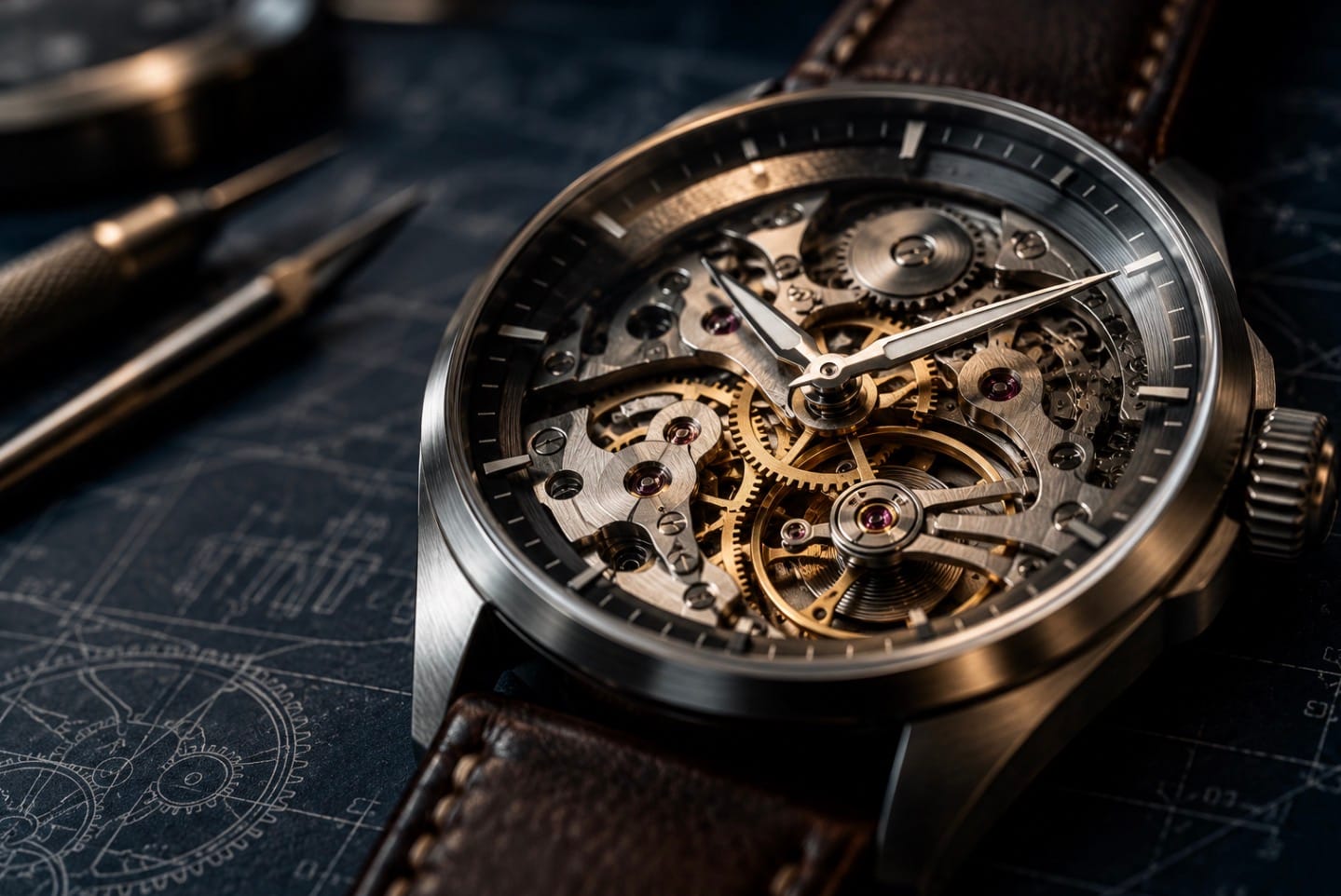
In a world where our phones can tell us the time instantly, it is fair to ask: why would anyone still want a mechanical watch? On the surface, a mechanical watch has a simple purpose: to tell the time. Beneath the dial, however, lies one of engineering’s most impressive miniature machines. With no battery and no AI, the mechanical watch has been around for over five hundred years, and through an intricate system of springs, gears and precisely manufactured components invisible to the naked eye, the mechanical watch can keep time well whilst also running for well over forty hours from only five winds. But how can a machine small enough to sit on your wrist measure time with such precision?
The Heart of the Watch
At the centre of every mechanical watch lies a mainspring: a tightly coiled piece of metal that acts as the watch’s source of energy. When the crown is wound, more potential energy is stored in the mainspring. As it unwinds slowly, this energy is transferred through a series of tiny gears called the gear train. Rather than allowing the spring to release all its energy instantly, the gears divide and control its movement, eventually driving the hands around the dial.
However, simply having a source of energy is not enough to keep accurate time. If the mainspring were allowed to unwind freely, the hands would spin rapidly around the watch within seconds. Instead, the energy has to be released in precise and controlled measurements. This is the job of the escapement; this acts as a mechanical gatekeeper. This allows the gear train to move forward in tiny, regular steps, transforming the constant force of the mainspring into a controlled movement required to measure time.
The Brain of the Watch
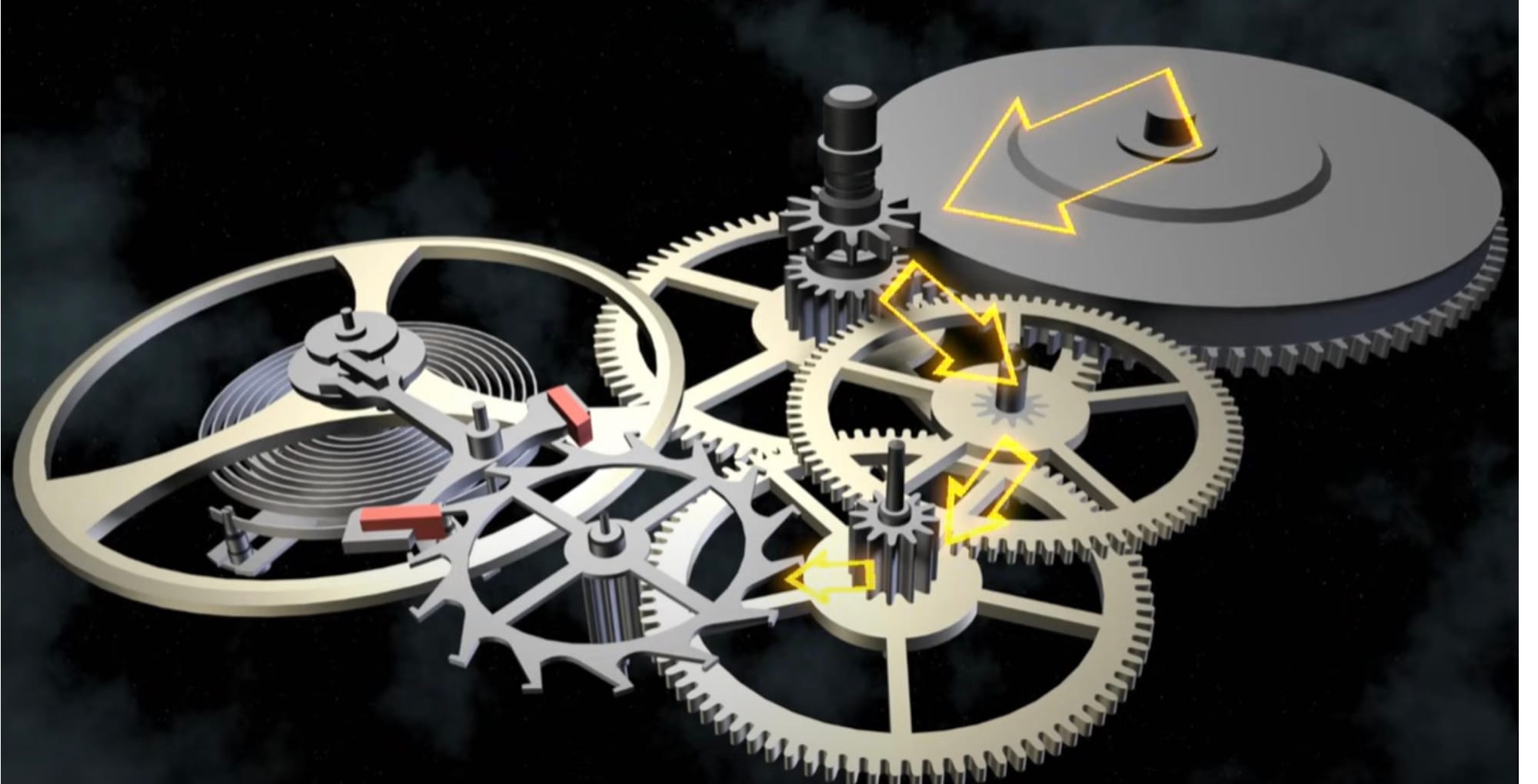
If the mainspring is the source of energy, the gear train could be described as the mechanical brain of the watch. It is made up of several tiny wheels, each with a different number of teeth. These gears transmit energy from the mainspring and control the speeds at which the hands move. The ratios between the gears have to be carefully calculated to ensure that the hands display the correct time. In a typical three-hand watch, the second hand completes one rotation every minute, the minute hand completes one every hour, and the hour hand completes one every twelve hours. All of this happens automatically, without electronics or a computer telling the watch what to do.
The clever part is how the different gear ratios produce these different speeds. Each wheel transfers motion to another, with the number of teeth determining how quickly the connected gears rotate relative to one another. Some wheels turn faster than others, allowing the movement to drive the hands at precisely the required rates. It is a bit like the gears on a bicycle, except on a microscopic scale, where every component must work together with remarkable precision.
The Ticking Regulator
At the core of the watch, the balance wheel, escapement and hairspring are responsible for keeping a mechanical watch ticking at a steady rate. The balance wheel swings back and forth, while the hairspring acts like a tiny coiled spring, helping the wheel return with each swing. Together, they form the watch’s regulator, determining the rhythm at which it keeps time.
At the same time, the escapement connects this regulator to the gear train, releasing energy in tiny, controlled increments rather than allowing the gears to spin freely. As the balance wheel oscillates (it rotates back and forth continuously on its pivot), the escapement repeatedly locks and unlocks, allowing the gears to advance in measured steps. This creates the familiar ticking sound of a mechanical watch. The process repeats thousands of times every hour, allowing the hands to move steadily around the dial.
Precision on a Microscopic Scale
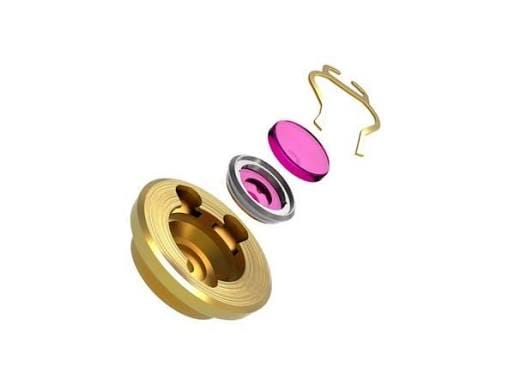
One of the most extraordinary elements about a mechanical watch is how detailed and precise its parts have to be made. Inside the movement, even tiny imperfections can make a difference. Like the butterfly effect, one tiny imperfection can cause the whole mechanism to fail. This is why watchmakers use jewels: these tiny pink synthetic rubies are located at important points where moving parts rotate. These jewels reduce friction and wear, allowing the movement to work smoothly for years.
The parts themselves are also manufactured to incredibly small tolerances. A screw that is only slightly too tight, or a component that is a fraction too large, could affect how the entire movement performs. This is part of what makes mechanical watches so impressive: hundreds of separate components have to fit together almost perfectly, just to perform a simple everyday task. What looks simple from the outside is actually an extraordinary example of precision engineering and an astonishing series of different components all working together in harmony.
More Than Just A Watch
What I find most impressive is that all of these tiny parts are working together without us even noticing. You can look at the watch and simply see two or three hands moving around a dial, but underneath, it is a whole machine constantly working away. A good mechanical watch can also be serviced, repaired and kept running for decades, sometimes even being passed down through a family. In contrast, a digital watch has around 2 years until it needs a battery replacement and looks clunky on your wrist with all the buttons. It generally lacks the elegant style of the mechanical watch, and that is what makes a mechanical watch more than just a way of telling the time. It is a piece of engineering that you can actually wear.
To answer the question “Why would you still wear a mechanical watch?”, the answer is a complicated one, and it varies massively from person to person. For some, the reason may be that it serves as functional art, a symbol of craftsmanship, or a tangible antidote to the modern digital world. For others, it may be a family piece passed down from generation to generation, or for aesthetics and style on their wrist. But whatever the reason, the mechanical watch industry still thrives 500 years later, and mechanical watches are commonly worn in public today.
The Future of the Watch Industry
So, what does the future look like for the mechanical watch? With smartwatches becoming more advanced and phones able to do almost everything a traditional watch can, it might seem like mechanical watches are slowly becoming outdated. However, I don't think they are going anywhere. In fact, their lack of modern technology is part of what makes them special.
Smartwatches will continue to become more useful, with better health tracking, communication and technology built into them. Mechanical watches cannot compete with that, and they don't need to. Their appeal comes from something completely different: craftsmanship, engineering and the satisfaction of owning something that has been carefully made to last.
The watch industry will probably continue to change, but the mechanical watch has already survived hundreds of years of technological progress. If it has made it this far, I think it is safe to say that this tiny mechanical masterpiece still has a future.
Bibliography:
Tufina. "Why Do Men Still Prefer Mechanical Watches Over Smart Watches?" Too Many Requests, tufinawatches.com/blogs/news/why-do-men-still-prefer-mechanical-watches-over-smart-watches?srsltid=AU7gw4ULuyOykGG8wrENiDtKFPNc_jRU9VCoutA4qV1gnPDkRSd2lFal. Accessed 16 Oct. 2026.
Wristwatch Revival. "How to Disassemble (and Reassemble) a Watch Movement Using Simple Tools." YouTube, 10 Oct. 2024, www.youtube.com/watch?v=_9czt3IK-o0. Accessed 16 Oct. 2026.