The Hall Effect
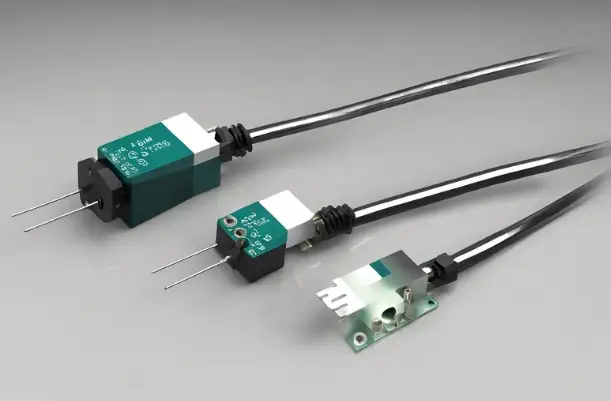
The Hall effect is one of those electromagnetic phenomena that by name seems unassuming, yet quietly runs a huge amount of modern technology. In its simplest form, it is the production of a stable voltage across a conductor that is transverse to the electric current flowing through it and a magnetic field. This voltage is extremely small, which is why the person who first noticed it was working with a sensitive galvanometer and a very thin strip of gold foil. The reason this effect actually matters is that it does two things: it shows the sign and density of the charge carriers in a material and gives engineers and scientists a reliable way to detect magnetic fields. This phenomenon created the framework behind which many modern sensors and technology operate, and also led to a major breakthrough and discovery at the time.
The story begins in 1879 at Johns Hopkins University in Baltimore, Maryland. Edwin Herbert Hall, a graduate student working under the supervision of Henry Augustus Rowland, was investigating how magnetic fields interacted with electric currents and building on James Clerk Maxwell’s electromagnetic theory. Previously, Maxwell had claimed in his Treatise on Electricity and Magnetism that the magnetic force acted only “on the conductor which carries it [the current]” rather than the charge carriers themselves.
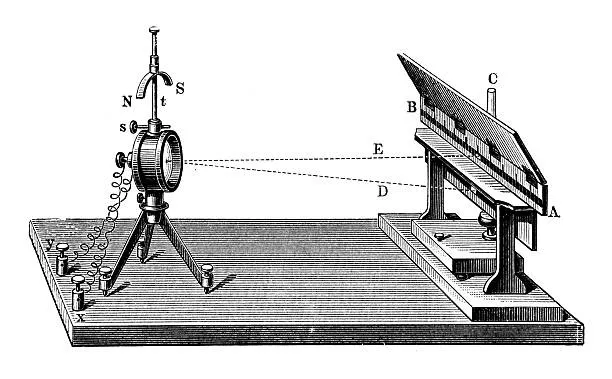
Hall was skeptical of this claim; he reasoned that if a magnetic field acted on the current itself, it should push the current towards one side of a wire, producing a small but measurable voltage. After one failed attempt, Rowland suggested using a thinner conductor to exaggerate the effects of current density (which is now known to be proportional to the Hall voltage), and on the second attempt on the 28th of October 1879, Hall succeeded in measuring a clear and persistent deflection of the needle on a galvanometer (a machine for measuring current) - a transverse voltage on the order of a few microvolts. Crucially, the sign of the voltage told him the charge carriers were negative (i.e. electrons), which ran counter to the prevailing notion that current was carried by positive charge. Hall describes this in his paper "On a New Action of the Magnet on Electric Currents":
Owing probably to the fact that the metal disk used had considerable thickness, the experiment at that time failed to give any positive result. Prof. Rowland now advised me, in repeating this experiment, to use gold leaf mounted on a plate of glass as my metal strip. I did so, and, experimenting as indicated above, succeeded on the 28th of October in obtaining, as the effect of the magnet's action, a decided deflection of the galvanometer needle. This deflection was much too large to be attributed to the direct action of the magnet on the galvanometer needle, or to any similar cause.
A moving charge in a magnetic field experiences a Lorentz force F = q(v × B), which points perpendicular to both the drift velocity and the field (think 'right-hand rule'). Without a magnetic field, the charge carriers travel in straight lines between collisions with impurities and vibrations of the metal lattice. However, once a magnetic field is applied, they curve and collect on one face of the material, while the opposite face becomes depleted of charge. This charge balance builds up an electric field that opposes the magnetic deflection. Almost instantly, a steady state is reached when the electric force and magnetic force balance: qE = qvB and a stable voltage is maintained for as long as the current flows.
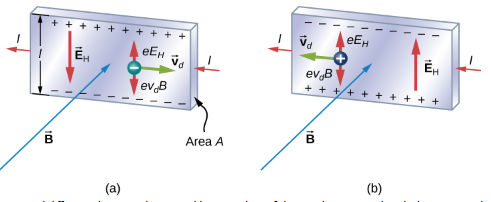
This equation yields the drift velocity v = E/B. The strength of the uniform field E equals the Hall voltage V divided by the thickness t. Combining with the current transport equation I = nqvA, we get an expression for the Hall voltage:
VH = BI ntq
To quantify this effect, physicists use the Hall coefficient RH which is defined as the ratio of the induced electric field (E) to the product of the current density (J) and the magnetic field (B). It is also related to the Hall voltage as follows:
VH = RHIB t
Since this value depends on the type and quantity of the charge carriers, it is intrinsic to the material. Moreover, measuring it lets you determine the density of charge carriers, and from the sign of the voltage, whether the dominant carriers are electrons (negative) or holes (positive). This is why the Hall effect was so valuable: it was one of the first real proofs that currents in most metals are carried by electrons rather than protons, and it showed that in p-type semiconductors, it is more accurate (and practical) to think of the current as positive holes, absences of charge in the valence band, rather than negative electrons.
The "default" Hall effect is only the starting point of a whole family of related phenomena. In ferromagnetic materials, the effect can arise with no external magnetic field; rather, it depends on the material’s own magnetic field instead, which physicists call the anomalous Hall effect. The Hall voltage in these materials is far greater than that of a non-magnetic conductor.
Up until the 20th century, however, these discoveries had no practical use. It wasn't until the advent of semiconductors that it became practical to build cheap sensors around the Hall effect due to the exaggerated Hall voltage which semiconductors produce compared to ordinary metals.
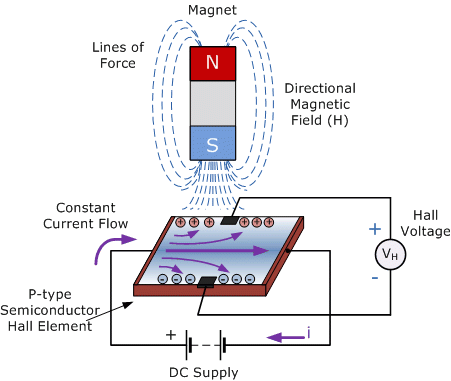
Since they work without physical contact, they are both robust and easy to scale down, which is why they have spread into so many places. A traditional switch or potentiometer both takes in dust and requires physical contact to work, whereas a Hall sensor only needs a magnetic field, so it isn’t subject to mechanical fatigue and can operate in harsh environments, including under the hood of a car or inside a pneumatic cylinder. That durability is a massive reason the technology has been so widely adopted: it simply keeps working where a contact-based device would fail.
The Hall effect especially earns its keep in the Hall effect sensor, which are devices that convert a magnetic field into an electrical signal. In the automotive world, they are used for wheel speed sensing in braking systems as well as for detecting the crankshaft and camshaft position to time engine ignition. In consumer electronics, they detect whether a smartphone's cover is open or closed, as well as hall effect keyboards that are complete with features such as rapid trigger and ultra-low latency. They also fill industrial demands for position and speed sensing, as well as current control; they are even being used in household appliances such as washing machines for monitoring drum rotation.
The key takeaway is that the Hall effect is a small voltage arising from the Lorentz force acting on moving charges in a magnetic field, which was first observed by Edwin Hall in 1879. What started as a subtle curiosity that proved charge carriers to be negative has grown into an industry staple of sensor technology. Even though it may not seem like it, the Hall effect has grown to become silently involved with our everyday lives.
Bibliography:
Maxwell, James Clerk. A Treatise on Electricity and Magnetism. Cambridge: Cambridge University Press, 2010. Print. Cambridge Library Collection - Physical Sciences.
Hall, Edwin H. "On a New Action of the Magnet on Electric Currents." John Hopkins University Press, cc.ee.ntu.edu.tw/~thlin/E_Hall_paper_1879.pdf.
SciHub101. "The Hall Effect Discovery of 1879 Explained." SciHub101, 4 Oct. 2026, scihub101.com/experiments/hall-effect-discovery-1879.