How The World’s Scariest Rides Became So Safe
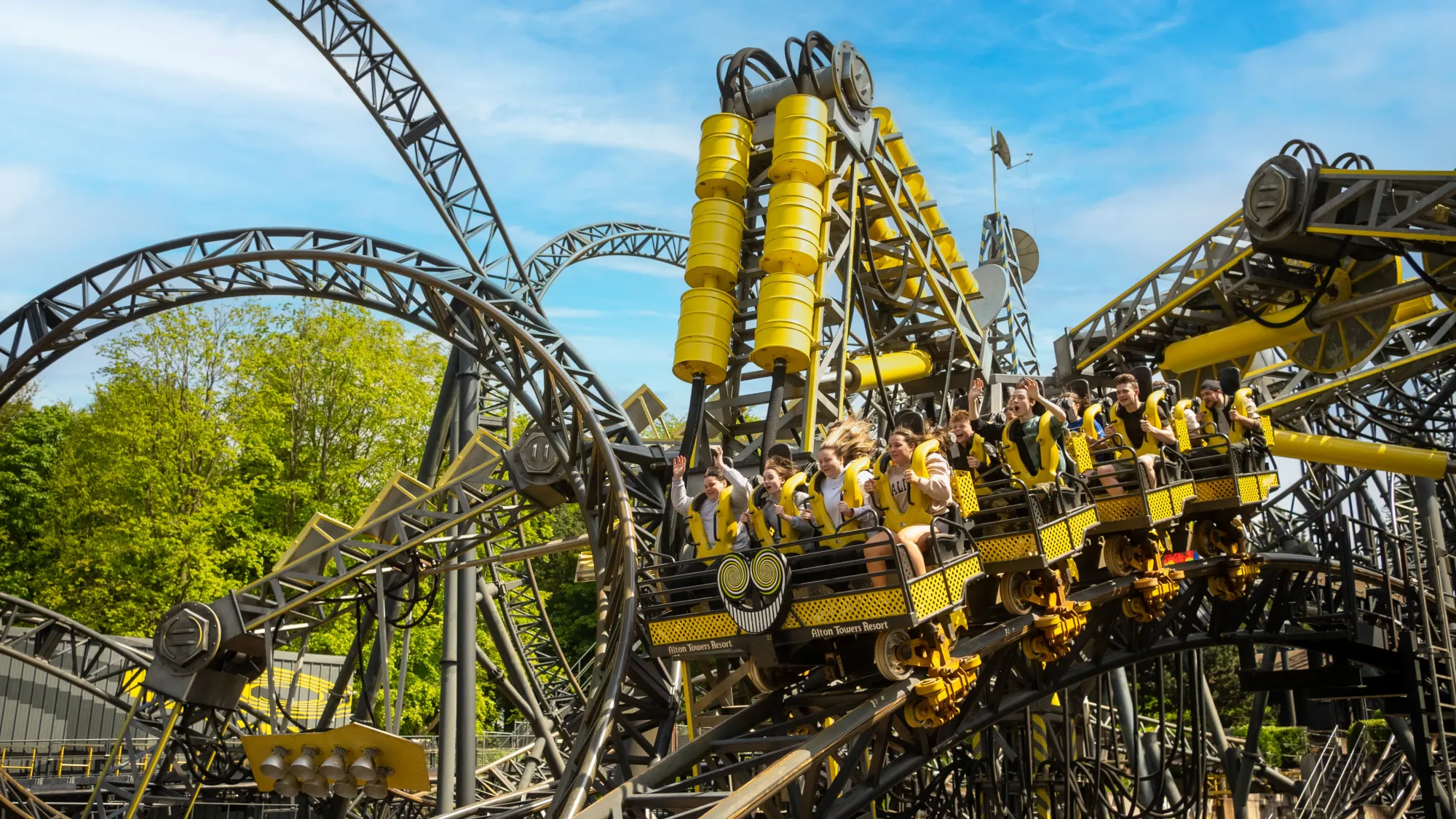
Click. Click. Click. 70 meters above the ground, the train slows to almost a walking pace. Your heart pounds against your ribs. Somewhere in this mechanical beast, the lift chain hauls several tons of steel and passengers to the top of the lift hill. The restraints press against your legs as the clicks slow to a stop. Your hands clench the restraints. Your eyes shut. You brace.
Freefall.
Your stomach hurls to your chest before sudden turns whip you into your seat. The beast roars beneath you as it twists through the layout, relentless but exhilarating. For a few seconds, your body tells you that you are in grave peril, that something has gone terribly wrong. But it hasn’t.
In fact, almost everything around you have been meticulously engineered to be one of the safest forms of recreation. Statistically, the chance of suffering a serious injury on a fixed-site amusement ride in the United States is roughly one in 15.5 million rides. To put that into perspective, you are approximately 2000 times more likely to die in a car crash than to get seriously injured on a roller coaster. But how are roller coasters so safe? How can something made to feel so dangerous be so far from it?
Wheels
To answer that, let’s start with the basics. The wheels. In June of 1884, LaMarcus Thompson opened the world’s first modern roller coaster in New York. Travelling at a top speed of 6mph, people would ride on simple benches with wheels over several gentle wooden hills. It was innovative at the time, but soon people wanted more, faster rides, steeper drops and more intense forces.
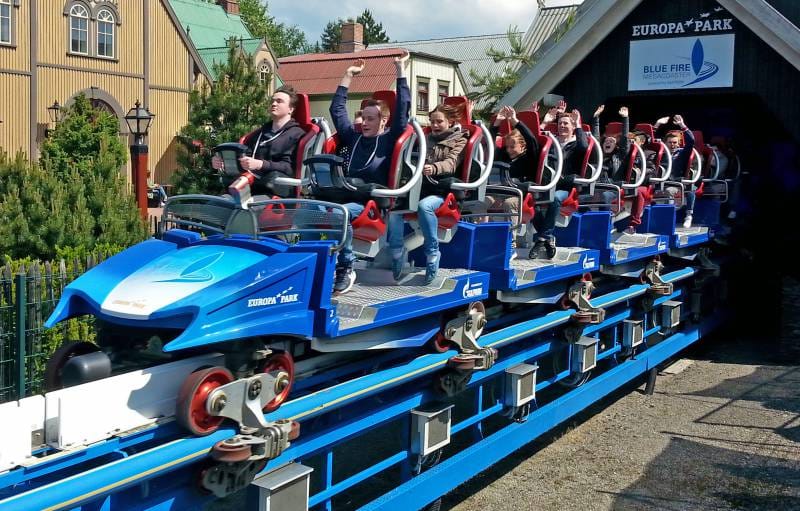
However, that created an engineering problem. One of the most popular sensations on a roller coaster is airtime. That weightlessness as you’re lifted out of your seat on a drop or the forceful pop that pushes you against your restraint in an airtime hill. With only 4 wheels (running wheels) touching the top of the track, keeping the train on the rails became a challenge. This led to designer John Miller patenting under-friction wheels (up-stop wheels) in 1919. Upstop wheels were another set of wheels under the rail, preventing the train from lifting off the track.
Yet adding up-stop wheels only solved part of the problem. Imagine a high-speed turn; as the track changes direction, there are often extreme lateral forces, which could easily derail the car and cause severe friction between the chassis and the track. This is where guide wheels (or side-friction wheels) come in. Installed perpendicular to the running and up-stop wheels, it runs against the side of the running rails on the track, helping to keep the train centered and smooth through turns. Together the wheels wrap the train securely around the rails, locking it onto the track.
Lift Hills
Now that the train can stay on the track through high-speed track elements, how does it get this speed? On most roller coasters, this is achieved using a lift hill. Thompson’s original 1884 Switchback Railway had no powered lift hill at all; it had to be pushed uphill manually. Just a year later, steam-driven hoists began doing the work mechanically, a concept that has been iterated on over hundreds of years to create the chain lifts we have today. On modern chain lifts, a roller chain is placed on the center of the track which the roller coaster latches onto using a chain dog. Modern chain lifts use a motor-driven chain which engages with a chain dog beneath the train, hauling several tons of steel and passengers uphill. But this creates an obvious safety question; what if the chain breaks or loses power halfway up?
Click. Click. Click.
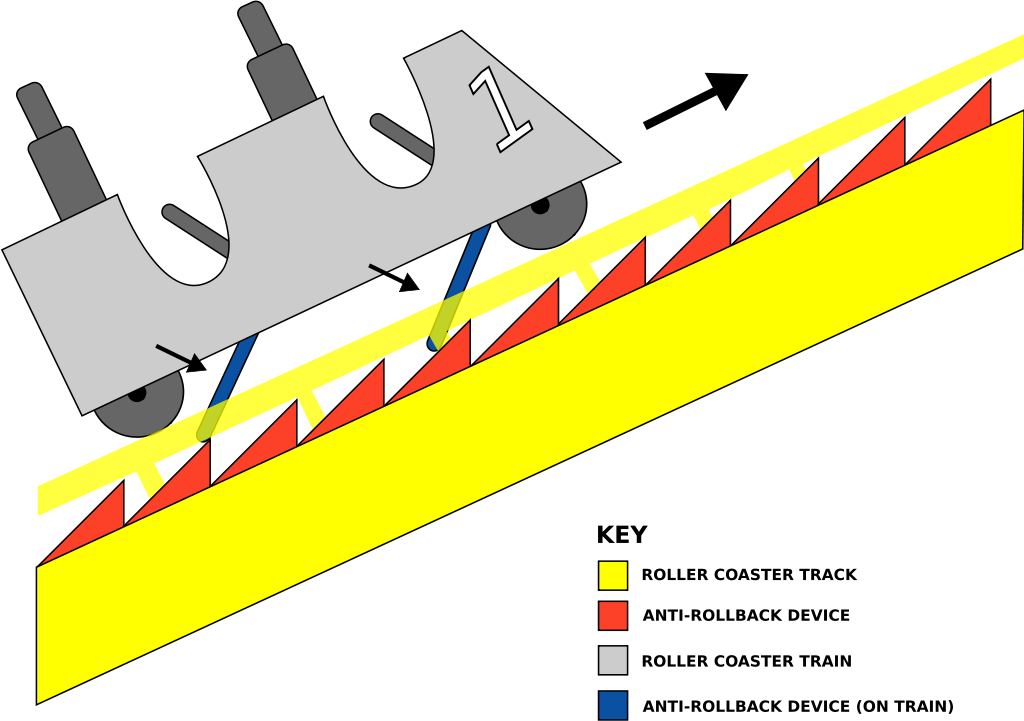
Remember that sound? It comes from the anti-rollback system. Under the train, there are anti-rollback dogs that ride over a row of angled teeth on the track called a ratchet rail. The clicks you hear are the anti-rollback dogs riding over the ratchet rail. If the train begins to move backwards, the anti-rollback dogs will catch against the tooth below, stopping it in place and preventing it from accelerating back down the hill into the station.

Brakes
Eventually, the train will reach the top of the lift hill, at which point gravity takes over and several tons of steel begins barreling through the layout. But that then raises another crucial problem; how do you safely stop the train?
Early coasters could be stopped by hand, however, as roller coasters got bigger, braking became a more serious engineering challenge. Many early coasters used a brakeman on the car itself. The brakeman would control a lever which when pulled, applied friction to the running wheels and slowed the whole train down. Obviously, such a system was labor-intensive, prone to human error and would not be viable as rides got more forceful.
Therefore, the solution was to move the brakes to the track. Early skid brakes used long wooden or metal strips that could be raised with a pull of a lever to create friction with the underside of the car. However, these were eventually superseded by the more sophisticated and controllable brake fins. Pairs of brake pads on the track would clamp onto metal fins attached to the underside of the car to slow it down.
But perhaps the most important development wasn’t a physical braking system, but the way of thinking. Most modern safety systems are designed to be fail-safe, meaning that in the case of roller coaster brakes, energy is required to deactivate it rather than activate it. For example, in a brake fin, powerful springs hold the brake pads closed while compressed air is required to open them.
Yet even the most effective friction brakes have an inevitable issue, wear and tear. Therefore, engineers developed a way of slowing roller coasters down that is both fail-safe and requires no contact.
Meet the eddy-current magnetic brakes. A metal fin beneath the train passes between powerful permanent magnets mounted to the track. As the conductive fin moves through the magnetic fields, electrical currents are induced inside the metal which then generate their own magnetic field that opposes the motion of the train. Because the braking force depends on how quickly the metal fin moves through the magnetic field, eddy-current brakes naturally produce a strong, smooth braking force at high speed without any physical contact. However, as the train slows down, the induced currents become weaker and so does the braking force. At very low speeds, the effect becomes too small to bring the train to a complete stop. That’s why magnetic brakes are often paired with conventional friction brakes and drive tires to bring the train to a complete stop and to control the movement of the train around the station. Magnetic brakes are also always active, meaning the ride WILL ALWAYS slow down. This ensures that modern day roller coasters come to a stop safely every single time.
Restraints
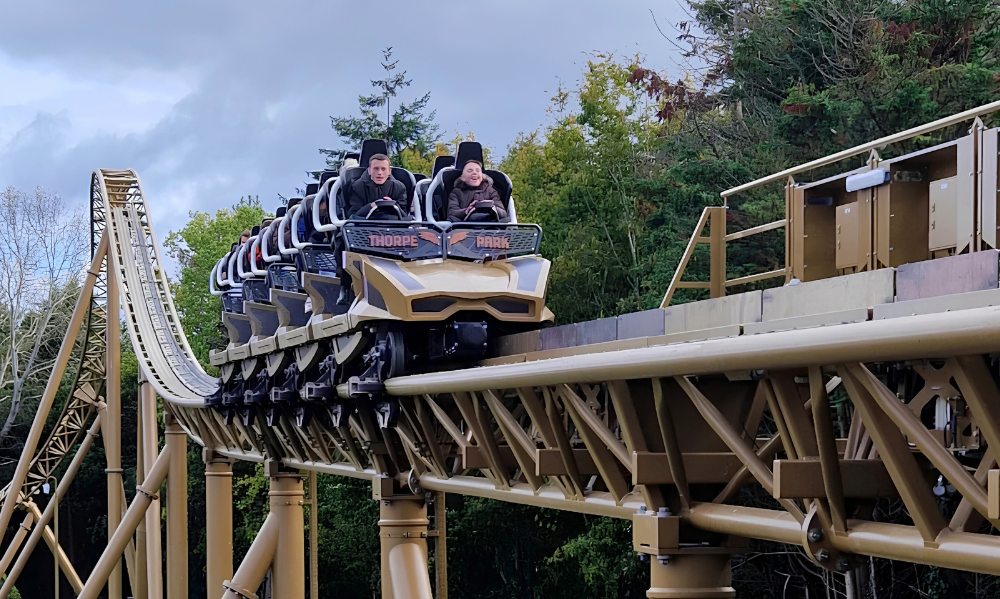
Of course, keeping the train safely on the track is pointless if the passengers do not safely stay inside it. Early roller coasters were gentle enough that riders often sat on simple benches with little restraint. As speeds and airtime increased, lap bars were introduced, first as simple fixed bars across a row and later as individual ratcheting restraints that could fit riders more securely. However, as roller coasters began inverting, designers increasingly turned to over-the-shoulder restraints. Instead of only securing the rider across the lap, these restraints came down over the upper body, giving riders more support through inversions and other extreme elements.
Interestingly however, modern restraint design has begun to move back towards lap bars. Going upside down doesn’t require a rider to be restrained by the shoulders, a rider just needs to be secured well enough to never fall out of the seat. By carefully shaping the seat and restraint around the rider’s lower body, modern lap bars can safely secure riders through inversions while leaving the upper body much freer. Nowadays, this is often regarded as the most comfortable restraint system with theme parks and ride manufacturers rushing to include lap bars on all their major rides.
The locking mechanism behind the restraint is just as important as its shape. One common design is the ratchet-and-pawl restraint. At the pivot point of the restraint, there is a cylinder that has multiple grooves around its circumference called a ratchet. As the restraint is pushed down, a pawl/pin moves over the teeth of the ratchet, allowing the bar to go down but not the opposite direction. This is why some roller coaster restraints make a distinctive clicking sound as they are lowered. These ratchet-and-pawl restraints often have multiple pins which means that if one pin were to break, which is already extremely unlikely, the other pin(s) can still hold the restraint in place.
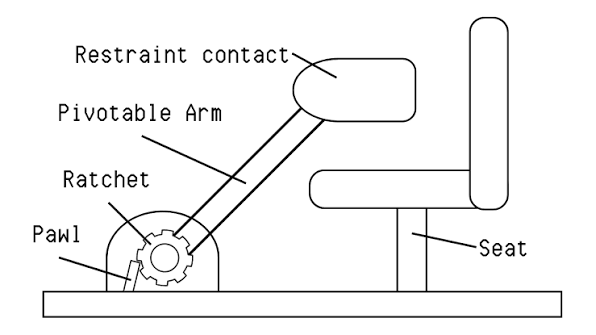
However, ratchet-and-pawl restraints can only lock at a fixed number of positions. This is why more modern rides use hydraulic restraints which can lock into almost any position without compromising on safety. Lowering the restraint moves a piston through a cylinder of hydraulic fluid. A one-way valve allows the fluid to move as the bar closes but prevents it flowing back in the opposite direction. Because the trapped fluid is effectively incompressible, the piston, and therefore the restraint, cannot move back upwards. On all types of restraints, there are also numerous additional fail-safe mechanisms and sensors to ensure the integrity of the systems.
So, what makes a roller coaster so safe? There isn’t one single invention. Wheels keep the train locked around the track. Anti-rollback systems stop it from racing backwards. Brakes are designed to never fail. Restraints keep each rider securely in place. And even that is only the tip of the iceberg. Modern rides also rely on block sections, sensors, control systems, careful track design, structural engineering, testing, inspections and maintenance. All these systems work together to make sure the ride stays safe.
So next time you reach the top of the lift hill and hear those final clicks beneath you, your body may be telling you you’re in danger. But behind all the noise, speed and fear, remember there is more than a century of engineering making sure that you aren’t.
Bibliography
"History Of The Roller Coaster — The National Roller Coaster Museum and Archives." National Roller Coaster Museum, 9 Nov. 2023, rollercoastermuseum.org/blog/history-roller-coaster-2.
"How Roller Coasters Actually Work." YouTube, 11 Apr. 2025, www.youtube.com/watch?v=irkAtqm-eCs&t=303s.
"IAAPA Ride Safety Reports." IAAPA.org, iaapa.org/safety-security/ride-safety-report.
"John Miller." Advancing Education Through Invention | Lemelson, lemelson.mit.edu/resources/john-miller.
"Just a Moment..." Library of Congress, www.loc.gov/everyday-mysteries/categories/physics/item/why-dont-i-fall-out-when-a-roller-coaster-goes-upside-down/.
"Restraints." Coasterpedia - The Amusement Ride Wiki, coasterpedia.net/wiki/Restraints. Accessed 9 Oct. 2026.
"Roller coaster brakes NEVER fail." YouTube, 12 Feb. 2023, www.youtube.com/watch?v=Yp2PVeidf2c.
"Roller Coaster Restraints: Explained." YouTube, 15 Sept. 2019, www.youtube.com/watch?v=oFsLdM7miUc.