Continuous Growth, Derivatives and Euler’s Number

The natural constant e is prevalent in pure mathematical calculations and also classical theoretical formulas across diverse disciplines. The Poisson distribution in statistics describes the frequency of random events. The transient processes of RC and RL circuits in physics characterise how electromagnetic signals evolve over time. The first-order reaction rate equation in chemistry represents the decay trend of substance concentration, and the logistic equation in biology models population growth constrained by environmental carrying capacity. From random probabilities and transient circuit variations to chemical reaction evolution and biological population dynamics, as the core constant for continuous change, e connects a variety of continuous growth and decay phenomena in many fields.
Continuous Growth and the Discovery of Euler’s Number
To begin explaining the unique properties and the beauty behind Euler’s number, we must first understand what exactly growth is. There are three main types of growth I would like to cover;
To begin, there’s linear growth (simple interest), which is a quantity that changes by a constant, fixed amount during each equal time period. A simple equation to illustrate this is:
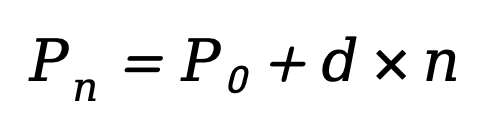
However, this isn’t the only type of growth. In real life, a number rarely grows in constant differences, they’re usually a percentage increase. This is called exponential growth where a number increases in percentages, meaning that every increase won't be the exact same. For example, if 100 pounds grows by 10% each time:
£100 → £110, £110 → £121, £121 → £133.10 → £146.41
The growth is constantly getting larger. this is exponential growth (compound interest). The equation for this would be
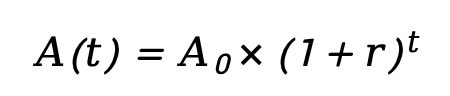
This is Discrete Growth meaning that changes happen in distinct steps or at specific, fixed time intervals (like once a year or month etc.).
In 1683, the mathematician Jacob Bernoulli was studying bank compound interest and conceived a limiting case. Imagine an extremely generous bank: you deposit a principal of £1, with an annual interest rate of 100%. If the bank compounds interest once a year and adds 100% interest to the principal at the end of the year, the total amount in your account will be:
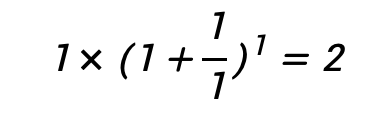
So now you have £2.
But what if the 100% interest is added in two periods, so in other words, twice?
Each time the rate is 50% (100% divided by 2):
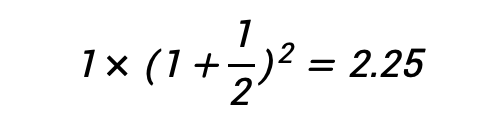
What about 4 times?
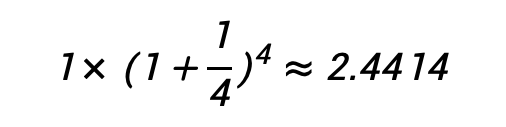
What about 12 times?
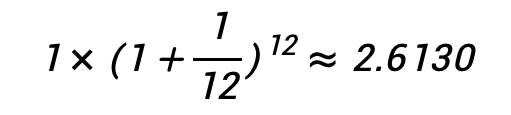
As we compound more and more frequently, one begins to realise that the number approaches a particular value:
2.718281828459…
That number is called Euler's number: roughly equaling to 2.71828
Another way to define e is:
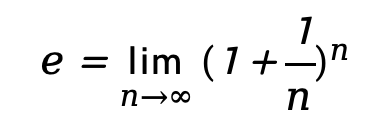
as the number of times we compound the 100% growth (n) increases towards infinity, the value outputted will get closer and closer towards e.
e is the key to the derivative of exponential functions.
According to the first principle of differentiation, the derivative of a general exponential function (y = a^x) cannot maintain a simple and unified form:
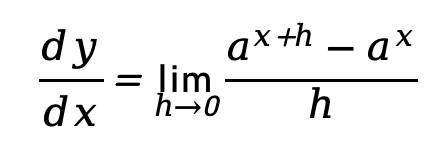
Its calculation is cumbersome and irregular.
While deriving the derivative formula for exponential functions, mathematician Leonhard Euler found that the instantaneous rate of change (dy/dx) on the graph of an exponential function increases as x rises. Accordingly, he wondered whether there exists a number a such that the derivative of (a to the power of x) is the function itself.
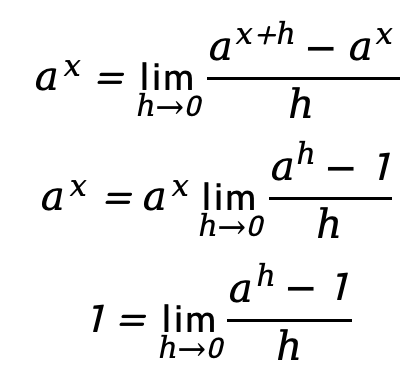
Now, we may rewrite h as:
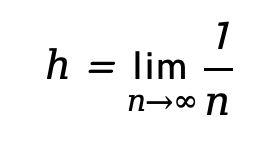
So:
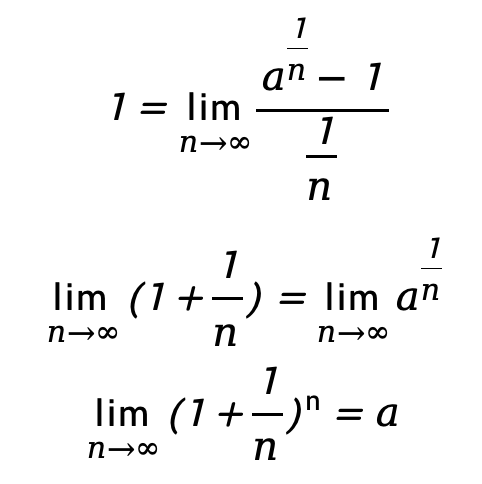
Therefore:
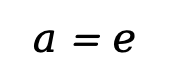
We could find that the exponential function with base e possesses a unique and superior mathematical property: the derivative of (e^x) is exactly equal to itself, expressed as:
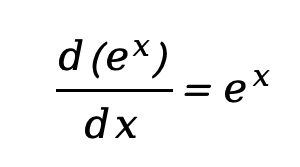
This exclusive property makes e the only base that simplifies the differentiation and integration of exponential functions perfectly. It eliminates complex constant coefficients and irregular operation rules, enabling exponential functions to become easy to analyse. Without e, the systematic study of continuous growth and decay laws would be hindered, and the complete theoretical system of exponential calculus could not be established. This also fundamentally explains why e inevitably appears in numerous interdisciplinary theories, thus becoming the core mathematical tool for describing the continuous changing laws in nature.
Conclusion
The reason why the natural constant e appears in classical theories lies in its unique mathematical nature: it perfectly describes all continuous, smooth, and self-proportional growth and decay processes. Unlike discrete mathematical tools that fit only specific scenarios, e naturally emerges whenever a change rate is always proportional to its current quantity. Since most physical motions, chemical reactions, biological developments, and probabilistic behaviours in nature follow continuous proportional variation, e becomes the unified core constant that connects mathematics, science, and engineering. Therefore, beyond being merely a mathematical number, e reflects the fundamental continuous law of nature, explaining its irreplaceable importance in interdisciplinary scientific systems.
Bibliography
- Euler, L. (1748). Introductio in analysin infinitorum (Vol. 1). Lausanne, Switzerland: Marc-Michel Bousquet.
- Bernoulli, J. (1690). Questiones nonnullae de usu reciproco serierum in mensura & motu . Acta Eruditorum, 12, 577–584.
- Maor, E. (1994). e: The story of a number. Princeton, NJ: Princeton University Press.
- Stewart, J. (2015). Calculus: Early transcendentals (8th ed.). Boston, MA: Cengage Learning.
- Ross, S. M. (2014). Introduction to probability and statistics for engineers and scientists (5th ed.). London, UK: Academic Press.
- Murray, J. D. (2002). Mathematical biology: An introduction (Vol. 1, 3rd ed.). New York, NY: Springer.