Can We Cool Down Our Cities By Painting Our Roads White?

Introduction
Especially in the summer, a city’s atmosphere can feel strangely different from the countrysides. The air seems heavier, thicker and the humidity leaves you covered head to toe in sweat, the buildings radiate heat long after the sun has gone down and even the pavement can become uncomfortably hot to walk on. This is partly a result of the urban heat island effect, where built-up areas absorb and store solar energy, making them warmer than the surrounding rural land. Our roads are a significant part of this problem. Most are covered in dark asphalt or tarmac which absorbs most of the sunlight that hits it. In summer especially, pavement can reach surface temperatures of around 48–67°C.
So why not change the colour? It sounds so easy to paint the roads white, reflect more sunlight, and the city should become cooler. The science behind the idea is real, but the answer is not that straightforward. A road is not an isolated surface, they are part of a much larger system, surrounded by buildings, pedestrians, vehicles which all interact with sunlight and heat.
Why Does The Colour Matter?
The scientific principle behind the idea is called albedo, which is a measure of how much incoming solar radiation a surface reflects. Dark surfaces have a lower albedo and absorb more radiation, whereas lighter surfaces generally reflect more. This is why standing on black asphalt in sunlight can feel much hotter than standing on a pale pavement because the darker road is absorbing more of the Sun's energy. The same idea is already being used on buildings where for example, cool roofs use reflective materials to reduce the amount of solar energy absorbed by a roof. However, roofs do not have to undergo the wear and tear of cars and pedestrians daily.
The road does not necessarily have to be bright white though. Reflective coatings and specially engineered paving materials can all increase its albedo. The aim is therefore not really to turn big cities into ones of white streets. The main focus is to reduce the amount of solar energy being absorbed by roads thus resulting in the reduction of average pavement temperature. In principle, the more radiation that can be reflected away before it enters the pavement, the less energy the road has available to heat itself and the surrounding environment. As well as the overall pro of cooling down the cities, roads will generally last much longer than if they were darker due to the fact that when tarmac and asphalt are heated too often, the roads will become deformed and sticky. So, the overall lifespan of one road would increase, meaning that less of government budgets would have to be spent on roads, which currently in the UK equates to about £8.1billion annually.
Does It Actually Work?
There is good evidence that reflective pavement can make the roads themself considerably cooler. A field study by Chaouki Ghenai in 2023 in a desert environment tested a highly reflective white pavement coating. The results showed that the treated pavement’s recorded temperature was around 15°C cooler than the untreated pavement. In one experiment, increasing the pavement's reflectance from 24% to 70% lowered the surface temperature from 60°C to 47°C. That is a substantial difference, particularly in cities where extreme heat already creates risks for the infrastructure and people.
Even though increasing the solar reflectance may result in cooler roads, it does not necessarily make a city cooler. Even if you replace all the darker roads for much more reflective ones, whilst the asphalt might be several degrees cooler, the buildings, roofs, pavements and vehicles around it are still absorbing sunlight. Urban temperatures are controlled by a mixture of surfaces, wind, shade, vegetation and a buildings shape. A large-scale experiment in Phoenix shows the difference. In 2026, researchers at ASU monitored an 11,500 m² cool pavement installation and measured surface temperature reductions of up to 8.3°C. The surrounding air also cooled, but by a much smaller amount of 0.58°C.
Although 0.58°C may sound insignificant compared to an 8.3°C drop but across a large urban area, even fractions of a degree can become significant during extreme heat. A small reduction in air temperature could also become more valuable when combined with other measures such as shade, vegetation and improved building design.
Will Reflecting Sunlight Become A Problem?
There is an obvious question that follows from all of this. Where does the reflected sunlight go? It does not simply just vanish. The solar radiation travels upwards and towards surrounding buildings. Research in Los Angeles found that reflective pavement can reduce the amount of heat stored in the road while simultaneously increasing the amount of radiation reaching people walking above it. In other words, the asphalt can be cooler while the person standing on it does not necessarily feel cooler.
The architecture of a city can make this effect even more complicated. For example, a narrow street surrounded by tall buildings, sunlight reflected from the road may hit walls rather than escaping upwards, leading to the opposite result of what this idea intended. Research by Elsevier into urban “street canyons” suggests that the ratio between building height and street width can influence whether reflective pavement produces a useful cooling effect. This means that a material which works well in a large, open car park could behave quite differently between two rows of tall buildings. A universal “paint every road white” policy would therefore be difficult to justify because the same surface could have vastly different effects depending on where it is used.
White Paint Is Not The Only Option
Scientists are looking at several different forms of cool pavement, rather than simply covering roads in white paint. Reflective coatings are one possibility because they can be applied to existing asphalt, potentially avoiding the need to completely reconstruct a road. Other approaches change the pavement itself, using lighter and more reflective materials. In 2026 a field experiment in Switzerland tested asphalt containing highly reflective ground calcium carbonate aggregates. The modified material reduced surface temperatures by up to around 5°C from the original asphalt while also increasing the pavement's albedo.
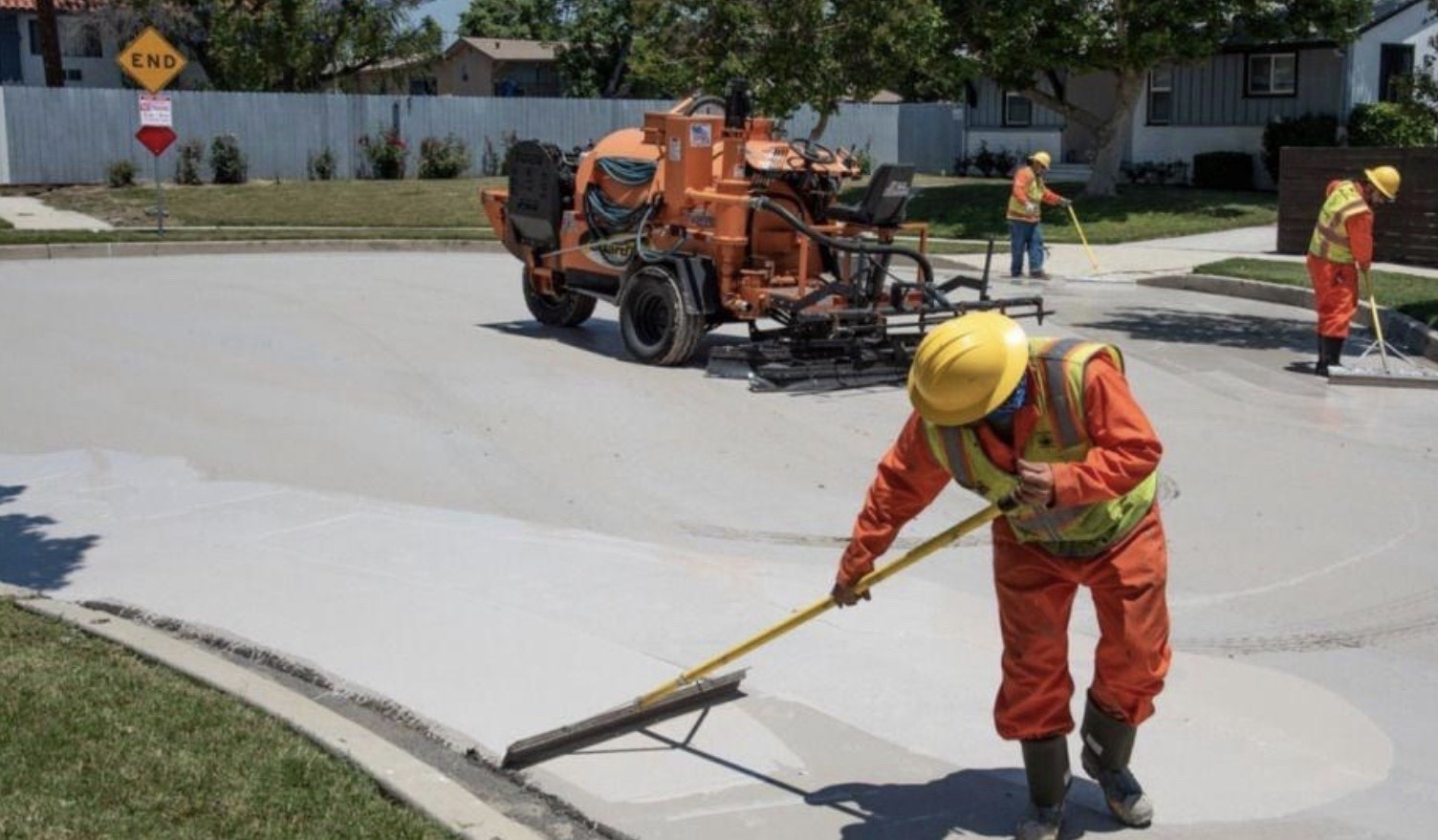
There is another approach which does not depend entirely on reflection: permeable and water-retaining pavements can allow water to enter and remain within the material. As the water evaporates, it removes heat from the surface. This could give these pavements an advantage beyond temperature reduction. The US Environmental Protection Agency (USPA) identifies reflective, permeable and evaporative pavements as different approaches to tackling urban heat.
The Environmental Cost Of A ‘Green’ Cool Road
Making something cooler does not automatically make it environmentally friendly, a reflective coating still has to be manufactured, transported and applied, and it may also have to be replaced as traffic and weather gradually wear it away. If producing and maintaining the material creates enough greenhouse gas emissions, some of the environmental benefit can be lost. A life-cycle study in 2017 of cool pavement campaigns in Los Angeles and Fresno found that the overall environmental impact depended heavily on the materials and construction methods used. In some instances, the energy and emissions involved in producing the treatment could outweigh the energy savings achieved during its lifetime.
Not only that but durability is another issue. Roads are not roofs. Thousands of vehicles drive over them every day, while dirt can also darken a surface and reduce its reflectivity. The Phoenix experiment provides a good example. Over 21 months, the mean solar reflectivity of its cool pavement fell by around 53%, from an albedo of 0.28 to 0.13. A road that begins highly reflective may therefore become considerably less effective with age. This raises the practical question for cities of is it worth installing a surface that requires frequent maintenance, or would money be better spent on solutions which provide several benefits at once, such as planting trees or creating green spaces?
So, Should We Paint Our Roads White?
Probably some of them. Cool pavements have an ability to reduce surface temperatures and studies increasingly suggest that large installations of them can produce measurable reductions in the surrounding air temperature. An overall review of cool-pavement research found that the cooling effects across several different approaches are reliable, although their effectiveness varies significantly according to the material and environment.
Nevertheless, roads represent only one aspect of the wider urban heat problem. Trees provide shade and lower surrounding temperatures through evapotranspiration, while green/solar panelled roofs limit the amount of solar energy absorbed by buildings. Urban planning can also play a significant role by spreading out tall buildings, improving airflow and reducing direct exposure to sunlight. The EPA therefore indicates cool pavements as one of several potential strategies, rather than a complete solution by itself. Ultimately, the most effective and efficient approach is likely to combine reflective surfaces with vegetation, shaded spaces, effective water/permeability management and improvements to the building layouts.
Conclusion
The idea of painting roads white initially sounds hysterically simple. Yet the physics and research behind it is difficult to argue with. It is the simple understanding that a surface that reflects more sunlight has less solar energy available to turn into heat. However, the complications begin once that road is placed inside a real city. Reflected radiation can reach pedestrians and buildings, the reflective material deteriorates, manufacturing has an environmental and monetary cost, and a road can become dramatically cooler without producing nearly the same reduction in air temperature.
Though, that argument does not mean that cool pavements are useless. Quite the opposite actually, as they could become a valuable part of how cities respond to increasingly frequent heatwaves, particularly when combined with trees, green spaces and a better urban design and layout. The future of cities will most likely not be a place of brilliant white roads. More likely, its pavements will be designed to behave differently depending on their environment and surroundings. So, we can cool down our cities by painting our roads white but the real challenge is not making a road white. It is working out how to make an entire city lose less heat without simply sending that heat somewhere else.
Bibliography
U.S. Environmental Protection Agency. (2012). Using Cool Pavements to Reduce Heat Islands. Available from: U.S. Environmental Protection Agency – Cool Pavements.
U.S. Environmental Protection Agency. (2008). Reducing Urban Heat Islands: Compendium of Strategies. Available from: EPA – Guide to Reducing Heat Islands.
Gilbert, H.E. et al. (2017). Energy and environmental consequences of a cool pavement campaign. Energy and Buildings, 157, pp.53–77. Available from: ScienceDirect – Energy and environmental consequences of a cool pavement campaign.
Kousis, I. and Pisello, A.L. (2023). Evaluating the performance of cool pavements for urban heat island mitigation under realistic conditions: A systematic review and meta-analysis. Urban Climate, 49. Available from: ScienceDirect – Cool pavement systematic review.
Sedaghat, A., Martin, E.P. and Sailor, D.J. (2026). Thermal impacts of large-scale cool pavement: Field results and methodological insights for urban climate studies. Urban Climate. Available from: ScienceDirect – Large-scale cool pavement study.
Orlando, F. et al. (2026). A mineral-based approach to cool asphalt pavements: Results from a field experiment. Building and Environment, 296. Available from: ScienceDirect – Mineral-based cool asphalt study.
Qin, Y. (Guangxi University-Elsevier) (2015). Urban canyon albedo and its implication on the use of reflective cool pavements. Energy and Buildings, 96, pp.86–94. Available from: ScienceDirect – Urban canyon albedo study.
UCLA Luskin School of Public Affairs. (2020). On-the-ground guidance for L.A.’s far-reaching climate strategy. Available from: UCLA – Cool streets research.