Why Turbulence Remains Physics' Greatest Mystery
From candle flames to Jupiter's storm — the chaotic motion of fluids has defeated the greatest scientists for centuries.
Depth Of The Problem
Werner Heisenberg, the physicist who helped found quantum mechanics and gave us the uncertainty principle, was assigned this thesis problem by his supervisor. It was not because he thought it would be easy, but rather because he believed none of his other students were capable of even attempting it. The problem was turbulence. Heisenberg spent years on it. His mathematical ability allowed us to reshape our understanding of the atom, but yielded only partial results.
That perfectly illustrates everything you need to know about the difficulty surrounding turbulence. It is not a slight problem. Turbulence is everywhere: in the air over an aircraft wing, in the blood pumping through your arteries, in the weather swirling above your head, and in the storms raging on Jupiter. Despite centuries of effort from scientists, we still cannot fully predict, explain, or control it.
What Is Turbulence?
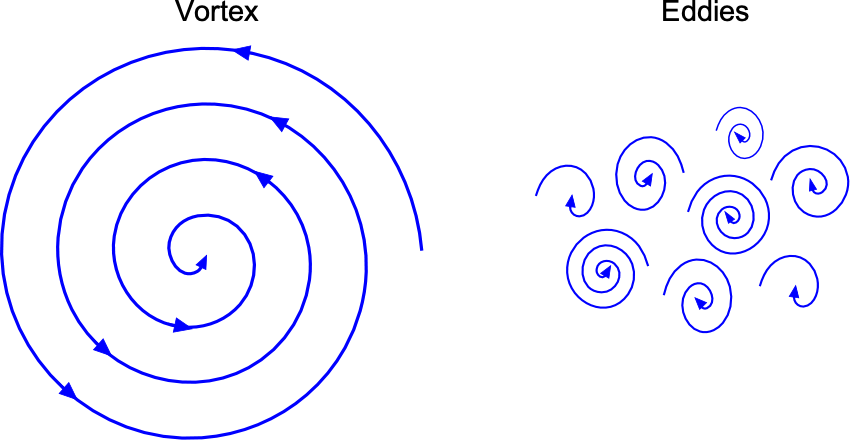
Here is a telling sign of just how complex the problem is: physicists cannot even agree on a precise definition of turbulence. The general idea is that it involves complex, chaotic motion in a fluid. What we do know is that turbulent flows are not simply messy versions of orderly flow. They exhibit structures called eddies (whirls), persistent vortices. They are almost organised patterns that emerge from chaos.
Leonardo da Vinci, who was among the first to systematically study and sketch turbulent flows in the early sixteenth century, seemed to grasp this. He was not merely drawing pretty pictures of swirling water; he was trying to capture turbulence through systematic observation.

The Equation at the Heart of the Problem
The central mathematical tool for describing fluid motion is the Navier-Stokes equation. Derived by applying Newton's second law — force equals mass times acceleration— to a fluid, it is a description of how water, air, and other simple fluids behave and has existed for nearly 200 years. And yet, in any realistic scenario involving turbulence, we cannot solve it.
This is not a matter of not having tried hard enough but rather a structural feature of the maths.
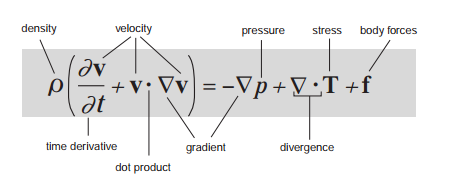
The problem is that the Navier-Stokes equation is nonlinear. In a linear equation, you can build complex solutions by adding together simpler ones. This is how we understand sound waves, and how quantum mechanics works. Turbulence does not work like this. Because of the equation's nonlinearity, you cannot construct a turbulent flow solution by stacking up simpler flows. Each situation must be attacked on its own terms, and in most cases of real interest, no exact solution exists at all. This is precisely why Heisenberg's genius, so effective in quantum mechanics, which is linear, ran into a wall when applied to turbulence.
The difficulty goes even deeper. We still do not know whether the Navier-Stokes equations have solutions. The equations may predict physically impossible patterns in some circumstances. Settling this question, in either direction, is worth one million US dollars and is one of the seven Millennium Prize Problems set by the Clay Mathematics Institute. As of today, it remains unsolved.
The Cascade of Scales
One of the most practically devastating aspects of turbulence is the sheer range of scales it operates across simultaneously. A turbulent flow contains motion at scales ranging from the wing of a plane to the near-molecular level, where energy is finally dissipated as heat. To simulate such a flow accurately on a computer, you would need to model every scale at once. Even if you drew the line in millimetres at the small end, you would need millions of grid points, each requiring calculation at every time step, something technology cannot provide at the moment but may be able to in the future with super-computers.
This is why the field of Computational Fluid Dynamics (CFD) has grown into a discipline of its own, demanding some of the most powerful supercomputers in existence. Engineers use sophisticated techniques such as adaptive mesh refinement, which concentrates computing power where the flow is most complex, in order to squeeze tractable answers from otherwise intractable problems. Even so, vast amounts of processing power are needed.
The Closure Problem: Infinity in the Equations
When physicists pursue a statistical understanding of turbulence, looking for general trends, they run into a different but equally stubborn wall. The nonlinear term in the Navier-Stokes equation creates an infinite chain of dependencies. To calculate the average velocity at one point, you need to know the velocity correlation between two points. To find that, you need three-point correlations, then four-point correlations, and so on. The chain never terminates on its own.
This is known as the closure problem. To make any progress, physicists must essentially take educated guesses, in other words, cut off the infinite chain at some point. These assumptions are approximations based on intuition and experimental observation, in other words, not fully accurate.
Order Within Chaos
One of the most striking aspects of turbulence are that organised structures emerge and persist. The Great Red Spot on Jupiter, a storm system larger than the Earth that has endured for centuries within a highly turbulent atmosphere, is one of the most spectacular examples of a structure.
Experiments reveal isolated pockets of turbulence, called turbulent spots, that form within otherwise laminar flow (flow without turbulence) and have also put fluid into a state of chaos and then release it back into a calm, orderly flow on the other side, as if the chaos were contained within an invisible boundary. These spots persist, despite being made of nothing but fluid motion.
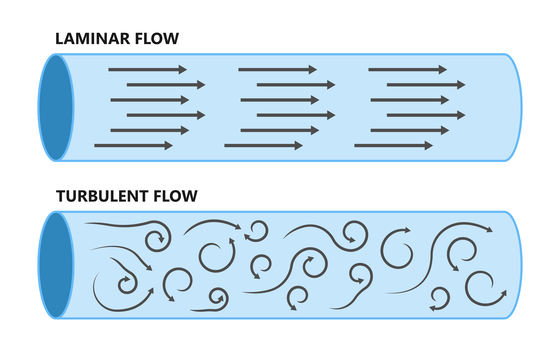
The existence of such structures suggests that turbulence is an order we do not yet have the theoretical and technological tools to fully describe. Most of these structures have been discovered through measurement, not predicted by theory. We observe them, catalogue them, and model them, but a genuine theoretical account of why they exist and how they form remains out of reach.
Why It Matters
The consequences of our incomplete understanding are far from merely academic. Turbulence factors directly into the design of aircraft, ships, pipelines, wind turbines, and engines. It shapes weather forecasting, climate modelling, and our understanding of ocean circulation. Since engineers cannot predict turbulent behaviour, the development of technology that interacts with fluid flows has been conservative without any theoretical insight. An understanding of turbulence would open up many advancements.
Bibliography:
- Inverse. (2017). What Causes Turbulence? The Chaotic Physics Mystery on Every Flight. [online] Available at: https://www.inverse.com/article/38385-turbulence-explained-physics-mystery
- Phillips, L. (2018). Turbulence, the oldest unsolved problem in physics. [online] Ars Technica. Available at: https://arstechnica.com/science/2018/10/turbulence-the-oldest-unsolved-problem-in-physics/
- Turbulence: one of the great unsolved mysteries of physics - Tomás Chor. (2019). YouTube. Available at: https://www.youtube.com/watch?v=S3i6tJ4XNqA.
- Hanks, M. and Hanks, M. (2022). Turbulence, the ‘Greatest Unsolved Problem in All of Science,’ Could Soon be Decoded. [online] The Debrief. Available at: https://thedebrief.org/turbulence-the-greatest-unsolved-problem-in-all-of-science-could-soon-be-decoded/.

![Image via [Adobe Stock]](/content/images/size/w600/2026/03/IMG_0874.jpeg)
