Why the Earth Is Still Hot: The Physics of Planetary Heat and Radioactive Decay

Beneath our feet, the Earth is not stable and inert, but thermally alive. Temperatures in Earth's inner core exceed approximately 5,500 °C (comparable to the Sun's surface temperature), yet Earth formed approximately 4.5 billion years ago. Given this immense age, the question arises: “Why has the Earth not cooled completely?” The answer lies in the physics of planetary formation and the nature of radioactive decay. Although Earth is often regarded as a sphere of rock floating through space, it is an evolving thermodynamic system sustained by the immense energy source in its core, which continues to shape its geology today.
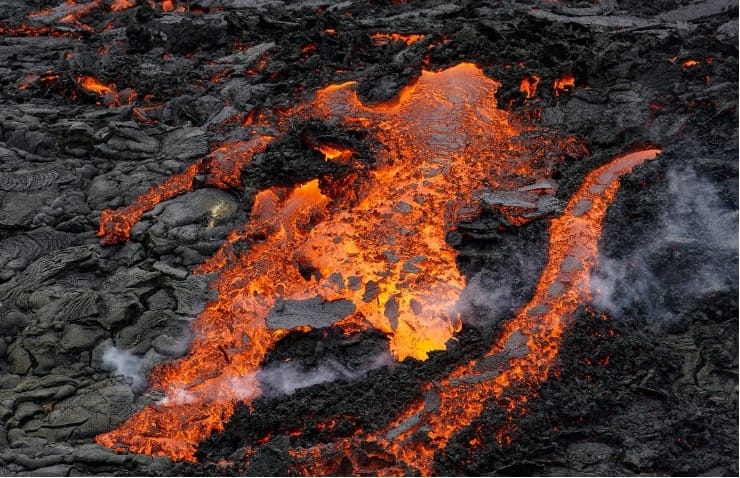
To understand the nature of the Earth’s heat, we must look back to its early formation. The prevailing model of the nebular hypothesis describes how dust and gas in the early Solar System were pulled together by the forces of gravity, causing these materials to coalesce into larger chunks called planetesimals. These objects continued to collide and merge (accrete), gradually forming the Earth. Every time two of these bodies collided, their gravitational potential energy (GPE) was converted into thermal energy (heat). Due to these impacts happening so often and so powerfully in the early Solar System, the young Earth became extremely hot. In fact, it was so hot that it formed a hellish and largely uninhabitable planet covered by a global “magma ocean” of molten rock. Using basic ideas about energy conservation, scientists can calculate how this conversion of GPE into thermal energy supplied a large part of Earth’s original heat. Surface lava offers us a glimpse into Earth’s internal heat engine.
However, primordial heat from Earth’s formation is only part of the story; if the Earth relied solely on accretional heating, then cooling over the past 4.5 billion years would have reduced the interior temperatures dramatically. The persistence of these high temperatures over such a long period requires a continuous internal heat source. This source is radiogenic heat, which is energy released during the radioactive decay of unstable isotopes such as uranium-238, uranium-235, thorium-232, and potassium-40. As these isotopes decay, they emit energy in the form of particles and electromagnetic waves, which are then converted into thermal energy in the surrounding material.
Radioactive decay follows an exponential law, described as a material's half-life (time required for half of the radioactive nuclei in a sample to decay). For example, uranium-238 has a half-life of approximately 4.5 billion years (almost exactly the age of the Earth). This remarkable coincidence means that a substantial fraction of Earth’s original uranium remains today, which continues to generate heat into the Earth’s core. According to the U.S. Geological Survey, radiogenic decay contributes to roughly half of Earth’s present-day heat flow, with the majority of that remaining from primordial heat from Earth’s formation.
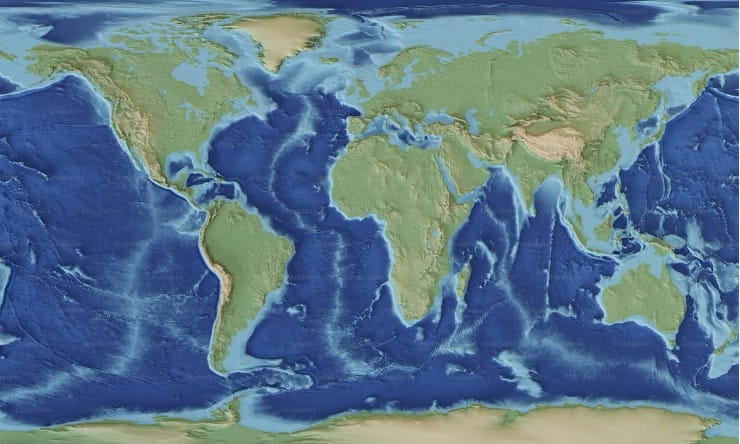
Globally, Earth’s internal heat flow/heat loss from the interior to the surface is around 47 terawatts. Measurements of heat loss across continental and oceanic crust reveal that heat escapes more efficiently through the thinner, denser oceanic lithosphere than the thick continental crust. This variation in heat loss strongly supports models of mantle convection, where more buoyant heated material ascends towards the surface, whilst denser cooler material descends, establishing a dynamic thermal circulation system within the Earth’s mantle.
Mantle convection is not merely a physical wonder but the driving force of plate tectonics. The motion of lithospheric plates (responsible for seismic activity and tectonic landform formation) is ultimately powered by internal heat from the Earth’s core. In this sense, radiogenic decay sustains the geological activity that keeps Earth habitable for life. Without this internal heat, plate tectonics would cease, carbon cycling would stall, and, critically, the stabilisation of Earth’s atmosphere over geological time would fail.
Ultimately, the seemingly simple question of “Why is the Earth still hot?” reveals something remarkable about our planet’s evolution over the past 4.5 billion years. Earth persists in an incredible energetic balance: heat produced in its interior gradually escapes into space, while radioactive decay continues to replenish part of that loss. This relationship between nuclear and planetary physics has sustained a geologically active world for over 4.5 billion years, enabling it to support life. As scientists better understand these processes, this knowledge is not merely academic but the foundation for interpreting the past and predicting the long-term evolution of our planet.
Earth will not cool to thermal dormancy any time soon. Deep below the crust, all these processes continue: atoms continuing to decay, energy continuing to transfer, and convection currents continuing to flow. Our planet’s internal fire remains the engine of the living world as we know it.
Bibliography
- 5.1 how to ‘Cook’ a planet: Sources of heat – Introduction to planetary geology. (n.d.). Introduction to Planetary Geology. https://pressbooks.cuny.edu/introplanetarygeology/chapter/1351
- Earth's internal heat budget. (2025, October 3). Wikipedia, the free encyclopaedia. Retrieved February 27, 2026, from https://en.wikipedia.org/wiki/Earth%27s_internal_heat_budget
- Earth's internal heat flow. (n.d.). UGC Berkeley. https://ugc.berkeley.edu/background-content/earths-internal-heat/
- Heat transfer and thermal evolution of planets | Planetary... | Fiveable. (n.d.). Fiveable. https://fiveable.me/planetary-science/unit-4/heat-transfer-thermal-evolution-planets/study-guide/P7WDRl2KjZngNUTC
- Internal heat and geological activity. (n.d.). Teach Astronomy - Internal Heat and Geological Activity. https://www.teachastronomy.com/textbook/The-Terrestrial-Planets/Internal-Heat-and-Geological-Activity/
- Quantifying Earth's radiogenic heat budget. (n.d.). ScienceDirect. https://www.sciencedirect.com/science/article/pii/S0012821X2200320X