Why Is It Harder For Teenagers To Fall Asleep Earlier?

On average, adolescents tend to fall asleep and wake up later than children or adults. Teenagers aged 14-17 are recommended to get 8 to 10 hours of sleep each night (Hirshkowitz et al.). However, on a school day, only half of 16 to 17-year-olds were getting the minimum requirement of 8 hours of sleep (Evans-Whipp and Gasser). While very few children under the age of 12 to 13 went to bed after 11pm, 28% of adolescents aged 16-17 years old slept after this time. This article looks at how the tendency for adolescents to fall asleep later is naturally the result of biological factors that occur during puberty, such as a delay in circadian timing, a slower build-up of sleep pressure, and a later dim-light melatonin onset (release of melatonin under dim-light conditions), and at how environmental factors, such as disrupted light levels and early school start times can further delay and hinder teen sleep.
What is the Body Clock?
The body clock is an endogenous (built-in) mechanism that regulates the timing of certain physiological and behavioural processes, including the sleep-wake cycle. A master clock controls all the biological clocks in the body; nearly every tissue and organ has its own biological clock. This master clock, called the suprachiasmatic nucleus (SCN), is a small, paired nucleus located in the hypothalamus (part of the brain). The SCN regulates and synchronises circadian rhythms. In humans, it governs the sleep-wake cycle, as well as other important functions (NIGMS).
The circadian rhythm operates on a cycle of approximately 24 hours. External time givers, known as ‘zeitgebers’, help to synchronise the circadian rhythm with the 24-hour day (Crowley et al.) One of these zeitgebers is light and darkness, so the circadian system is sensitive to light, especially during the nighttime.
The circadian system regulates the timing of melatonin release, a hormone produced by the pineal gland in the brain. Melatonin helps signal to your body the onset (start) of biological night, contributing to the timing of sleep. During the daytime, levels of melatonin are extremely low, then in the evening levels rise, peak during the nighttime, and decline towards one’s usual wake-up time (Crowley et al.). Dim-light melatonin onset (DLMO) is a commonly used marker of the circadian system, defined as when melatonin begins to rise under dim-light conditions.
The Two Process Model
Borbély was the first to describe a model known as the “Two Process Model of Sleep Regulation”, describing the interaction between the circadian timing system (Process C) and sleep/wake homeostasis (Process S). The homeostatic sleep system is often described in terms of “sleep pressure” (Crowley et al.). What this means is that the longer you are awake, more sleep pressure builds up, so sleep drive increases.
Slow wave activity (SWA) is a marker of this “sleep pressure”, associated with process S (Crowley et al.). SWA typically peaks at the beginning of nocturnal sleep when sleep pressure is greatest and declines exponentially through the night (during non-rapid eye movement (NREM) sleep). Following a longer period of wakefulness, SWA tends to be greater during subsequent NREM sleep, reflecting increased sleep pressure.
How does the Body Clock Change during Adolescence?
As adolescents move through puberty, their circadian rhythm tends to shift later. In a longitudinal study, it was found that as participants became older, their DLMO occurred later. (Crowley et al.) A later DLMO means that under dim-light conditions (late evening to night) melatonin will be produced later. Melatonin is what helps to signal the onset of biological night, so this means that adolescents tend to experience this onset later, contributing to the tendency for adolescents to fall asleep later.
Moreover, it is found that sleep pressure (Process S) may build more slowly for more mature adolescents (Crowley et al.), allowing them to stay awake for longer. Together with a later DLMO, this change in sleep pressure may contribute to the later timing of sleep onset for the mature adolescent, making it more difficult for adolescents to fall asleep at an earlier bedtime.
Environmental Factors
The biological factors like a later DLMO, a delay in sleep timing, and a slower build-up of sleep pressure all contribute to the natural delay in adolescent sleep, but environmental factors play a part in further delaying and hindering teen sleep. This section discusses early school start times and the imbalance of light received during the day and late evening.
During the school term, teens have to wake up at the same time each day, but they still tend to sleep later, which reduces the overall amount of sleep obtained. It was found that on school mornings both children and adolescents woke up at around the same time each day: 7 AM (Evans-Whipp and Gasser). Despite this, adolescents still slept later. In a landmark study, a school district that changed school start times from 8:25 AM to 7:20 AM from 9th to 10th grade was examined (Carskadon et al.). The findings showed that adolescents in the 10th grade with the 7:20 AM start time woke up significantly earlier, but their bedtimes did not shift earlier and therefore they slept less. The 10th grade adolescents showed increased daytime sleepiness, and on the first morning of testing almost half of the 10th graders entered REM sleep only 10 to 15 minutes after sleep onset, an indication of substantial sleepiness.
Another environmental factor that further hinders adolescent sleep is the imbalance of light received during the day and late evening compared to natural outside light levels: today, people spend approximately 90% of their time indoors, where light levels are generally much lower than outdoors (Ricketts et al.), so during the day people receive reduced light levels, and increased light levels in the late evening. Light and dark is one of the zeitgebers that helps to synchronise the circadian rhythm to the 24-hour day, so the disruption of this light and dark cycle can further hinder sleep.
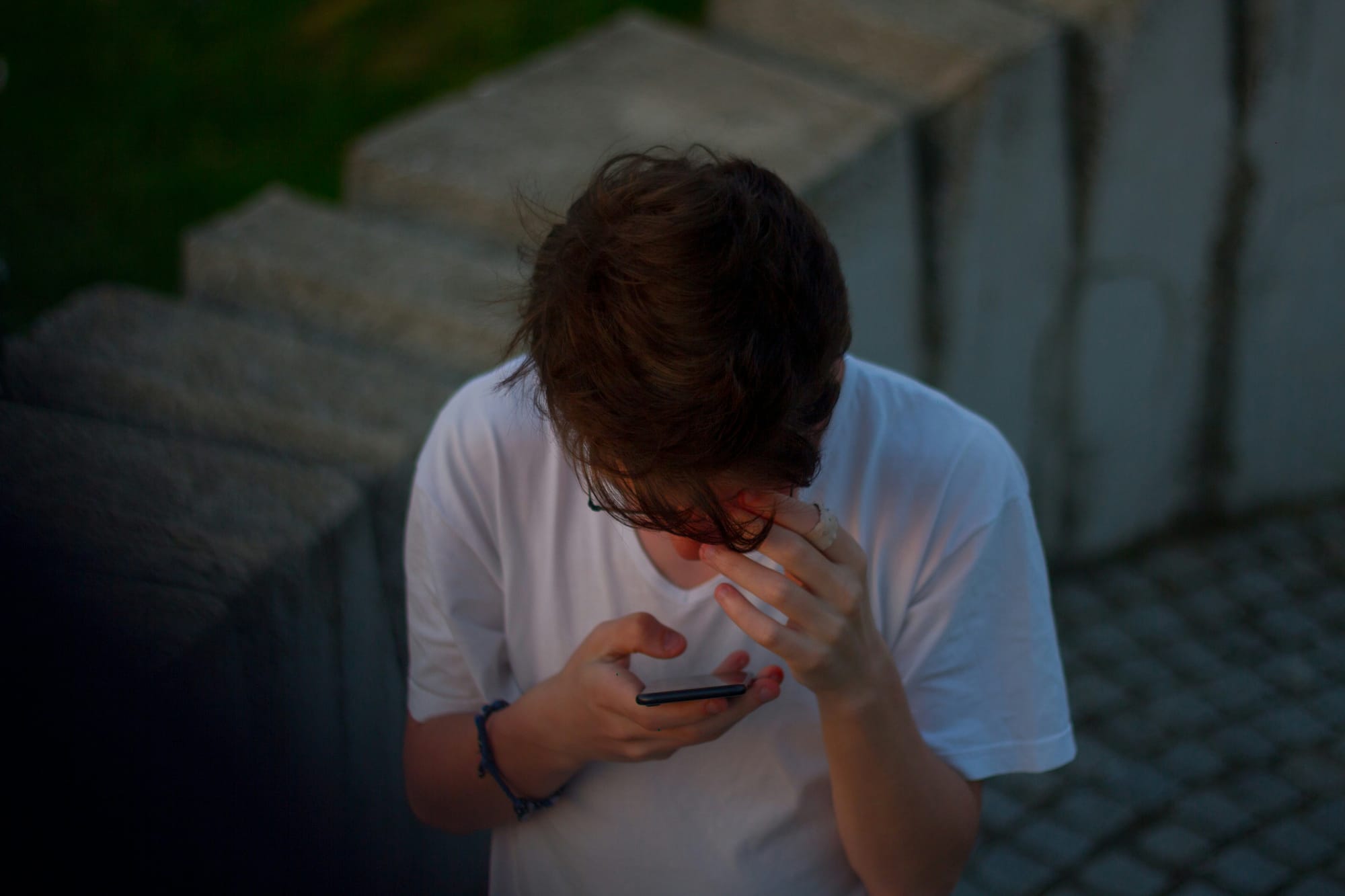
Although the circadian timing system is most sensitive to short-wavelength light (around 460nm) such as the blue light from phones, light intensity may be more important than light spectrum in disrupting sleep, and engaging with stimulating content online before bed may interfere with sleep. (Ricketts et al.)
Conclusion
During adolescence, it is naturally harder for teenagers to fall asleep earlier, as sleep pressure builds more slowly during the day, and during puberty adolescents tend to experience the onset of biological night later. It is the interaction between these two processes that helps explain the tendency towards a later circadian rhythm and a shift towards an evening “night owl” chronotype. Environmental factors such as evening light exposure and stimulating online content can further delay sleep, and, in the case of evening light, potentially contribute to a later circadian phase. Early school start times contribute to less sleep in adolescents, because even when school times shifted earlier, it did not cause bedtimes to shift earlier. So, it is not the case that it is harder for teens to sleep earlier just because of environmental or behavioural factors. Instead, biological factors contribute to a natural delay during puberty, and environmental factors play a part in further delaying and shortening adolescent sleep.
Bibliography
Carskadon, Mary A., et al. "Adolescent Sleep Patterns, Circadian Timing, and Sleepiness at a Transition to Early School Days." Sleep, vol. 21, no. 8, 1 Dec. 1998, pp. 871–881. https://academic.oup.com/sleep/article-abstract/21/8/871/2726004?redirectedFrom=fulltext. Accessed 4 Oct. 2026.
Crowley, Stephanie J., et al. "A Longitudinal Assessment of Sleep Timing, Circadian Phase, and Phase Angle of Entrainment across Human Adolescence." PLOS ONE, vol. 9, no. 11, 7 Nov. 2014, e112199. https://journals.plos.org/plosone/article?id=10.1371/journal.pone. Accessed 3 Oct. 2026.
Crowley, Stephanie J., et al. "An Update on Adolescent Sleep: New Evidence Informing the Perfect Storm Model." Journal of Adolescence, vol. 67, Aug. 2018, pp. 55–65. https://onlinelibrary.wiley.com/doi/10.1016/j.adolescence.2018.06.001. Accessed 4 Oct. 2026.
Crowley, Stephanie J., et al. "Sleep, circadian rhythms, and delayed phase in adolescence." Sleep Medicine, vol. 8, no. 6, 2007, pp. 602–612, https://doi.org/10.1016/j.sleep.2006.12.002. Accessed 27 Sep. 2026.
Evans-Whipp, Tracy, and Constantine Gasser. “Are Children and Adolescents Getting Enough Sleep?” LSAC Annual Statistical Report 2018, Australian Institute of Family Studies, 2018, pp. 59–76, https://aifs.gov.au/all-research/commissioned-reports/are-children-and-adolescents-getting-enough-sleep. Accessed 3 Oct. 2026.
Hirshkowitz, Max, et al. "National Sleep Foundation’s sleep time duration recommendations: methodology and results summary." Sleep Health, vol. 1, no. 1, Mar. 2015, pp. 40–43. https://www.sleephealthjournal.org/article/S2352-7218(15)00015-7/fulltext. Accessed 3 Oct. 2026.
National Institute of General Medical Sciences. "Circadian Rhythms." National Institute of General Medical Sciences, 20 May 2025, https://www.nigms.nih.gov/education/fact-sheets/Pages/circadian-rhythms. Accessed 29 Sep. 2026.
Ricketts, Emily J., et al. "Electric Lighting, Adolescent Sleep and Circadian Outcomes, and Recommendations for Improving Light Health." Sleep Medicine Reviews, vol. 64, Aug. 2022, article 101667. https://www.sciencedirect.com/science/article/abs/pii/S1087079222000806?via%3Dihub. Accessed 4 Oct. 2026.