THE SCIENCE OF RADAR
Radar is one of the most important sensing and detection technologies in the modern world.
Introduction
Radar is one of the most important sensing and detection technologies in the modern world. By transmitting radio waves and carefully analysing the returning signals, they are capable of determining the range, velocity and direction of objects in their field of view far beyond the capabilities of the naked eye. They are employed in numerous key applications such as detecting and tracking threats, air traffic control or determining weather conditions, providing vital information that would otherwise be extremely difficult or impossible to obtain. Yet as technology advances, military radar, the cornerstone of national defence and global security, faces an ever evolving, daunting challenge, detecting ever more potent threats designed specifically to evade it. How did we get here, and what does the future hold for radar?
Function – How It Works:
Radar captures and analyses the RF emissions and reflections of objects within its field of view using either a transmitter or, in the case of Passive radars another emitter of RF waves to observe and track things beyond the capabilities of the naked eye. Upon contact with an object or environmental feature, these waves scatter in different directions. These detections are processed with advanced algorithms to first remove noise and other environmental interference and then to classify the object and understand variables like its direction and speed. This process can be broken into four main steps:
1) Transmit:
The Radar emits narrow beams of electromagnetic waves in short or long pulses with a transmitter
2) Reflect:
Those waves can intercept and reflect off objects like missiles and planes, or simply just environmental clutter and precipitation
3) Receive:
The receiver takes in the reflected waves and measures aspects of this reflection such as time elapsed before return. This for example can be used to gauge its range.
4) Classify, & Act:
All of this digital data is then processed in real time with advanced data processing algorithms to help determine features of the object such a distance, direction, speed, shape to aid in making informed, correct, high-stakes decisions in response
History
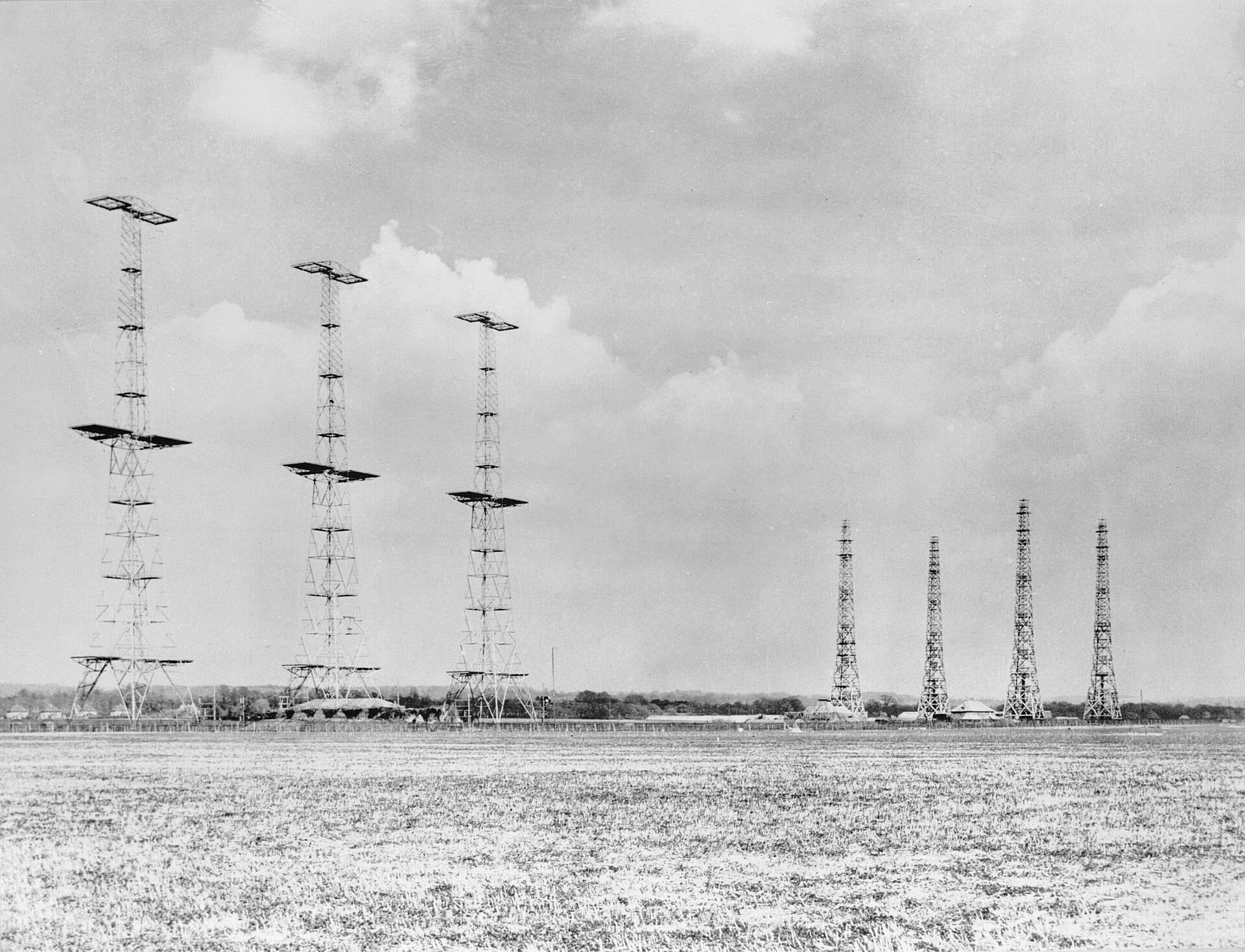
Nowadays, Radar is a standard piece of equipment in many industries however, before the second world war, it was treated with utmost secrecy. Some of the fundamental bases of Radar were first discovered by German scientist Heinrich Hertz when he realised that radio waves could reflect off objects. However, this discovery held no real practical use until the early 20th century when Christian Hülsmeyer designed a system to detect ships in 1904. Still, it would not be until the Great War that these ideas really got much proper attention and later still that they would see larger-scale deployment. With the emergence of aviation, the need arose to track and detect incoming threats. Amongst the first systems were the ‘Sound Mirrors’ employed by many European countries to try and detect the approaching engine sounds of enemy aircraft however this system didn't prove to be very accurate or reliable. Therefore the British government shifted its attention to Radio waves and established a series of radar stations along the southern coast which used pulses on a Cathode Ray Tube (CRT) screen to indicate the presence of objects. A controller would then use a ruler to measure these pulses and determine the range to the threat. It would not be until 1940 that the more familiar circular plan-position indicator (PPI) would be adopted, which displayed targets relative to the radar station. The same year, the US Navy officially coined the term ‘Radar' - ‘Radio Detection and Ranging’.
Following the Second World War, numerous new systems would emerge such as the Monopulse Radar, designed to increased tracking accuracy, the Pulse-Doppler Radar, which was capable of detecting moving objects far more effectively through noise and interference, and the Phased-Array Radar which was a key advancement in the capability of radar to track multiple targets and rapidly switch between them. This system would evolve into the ‘AESA’ – ‘Active Electronically Scanned Array’ system, still prominently used today in aircraft like the F-22. With the emergence of the Cold War and the Nuclear arms race, countries also began establishing extensive early warning radar systems to detect and intercept any enemy attacks. The discovery that waves could reflect off the ionosphere made it possible for radar systems to see further, less encumbered by terrain and environment. Nowadays, Radars are capable of detecting things like missile launches at ranges of a few hundred to a thousand miles depending on conditions like weather.
Different Applications:
Radars are used extensively in National defence due to their ability to provide vital warning against attacks and threats such as ballistic missiles, cruise missiles and enemy attack craft.
Airport Surveillance Radar (ASR) is vital in Air Traffic Control to help locate, track and coordinate aircraft. It also aids in the take-off and landing of planes in bad weather with poor visibility.
Radars are also used in the automotive industry. There are two classes of Radar used in automotive applications: Short-Range Radar (SRR), is used in parking assistance and blindspot coverage. Long-Range Radar (LRR), is used in cruise control and collision warning.
Weather Radars observe and analyse atmospheric reflections to detect and find areas of precipitation and other weather conditions. Doppler Radars and Polarimetric Radars are the two most common Radar technologies used in weather forecasting. Doppler radar is used to analyse the direction and speed of clouds and other atmospheric weather while Polarimetric Radar is used to measure various characteristics precipitation and turbulence such as type and magnitude.
The Future of Radar in Threat Detection and How Radar Will Evolve in Tandem With Stealth Technology:
The advancement of technology and the advent of ever more potent, increasingly common stealth technologies pose interesting new problems for the future of Radar. The core of Radar stealth technology is to shrink the radar cross section (RCS) of a craft. Stealth shaping technologies and material stealth technologies are two of the most commonly employed methods of minimising the RCS of an aircraft. Stealth designs employ surface features like slopes and curves to avoid perpendicular surfaces that reflect waves so easily back to the radar receivers. Radar absorbing materials are also used to coat the surface of stealth aircraft to absorb waves at specific frequencies.
Currently, with the stealth and counter-stealth arms race growing so rapidly and proving so expensive to research, the most prominent contributors to the field are China and America. According to a study published in 2025, between 2015 and 2024, China’s patent office recorded 160 acceptances for patents relating to stealth and anti-stealth technologies, compared with 98 in the United States. The study also recorded 42 through the World Intellectual Property Organization (WIPO) and 25 in Japan. Nowadays, Air combat is no longer simply a showdown of weapons and range, but now comprises a vast network of systems and an enormous amount of data necessary to overcome one's enemy.
The core of Radar anti-stealth technology is to augment the capabilities of radar against stealth technology. One key aspect is to employ it in a network alongside other systems such as satellites, airborne early warning aircraft and unmanned aerial vehicles to maximise the chances of detection. Netted radar is a collaborative detection system comprised of multiple radar nodes detecting with different systems, polarisation methods, and at different frequency bands. It adjusts each radar node carefully in accordance with the data it receives and the combat situation to enhance the ability to detect, track and identify stealth targets. The emergence of new advancements such as Artificial Intelligence also hold great promise in this field.
Despite the potency of new Stealth systems, Radar remains for the foreseeable future, a core pillar of defence and military threat detection. It is no longer viable to be used on its own, but now comprises a key level of a multi-layered defence network that act to defend nations across the globe.
Bibliography
Lockheed Martin (2021). How do radars work? [online] Lockheed Martin. Available at: https://www.lockheedmartin.com/en-us/news/features/2021/how-do-radars-work.html.
uk.mathworks.com. (n.d.). How do radars work? [online] Available at: https://uk.mathworks.com/discovery/how-do-radars-work.html.
SPARTAN COLLEGE OF AERONAUTICS AND TECHNOLOGY (2021). The history of radar | spartan college. [online] Spartan College of Aeronautics and Technology. Available at: https://www.spartan.edu/news/the-history-of-radar/ .
Lockheed Martin (2021). How do radars work? [online] Lockheed Martin. Available at: https://www.lockheedmartin.com/en-us/news/features/2021/how-do-radars-work.html.
uk.mathworks.com. (n.d.). How do radars work? [online] Available at: https://uk.mathworks.com/discovery/how-do-radars-work.html .
www.leonardo.com. (n.d.). The future of radar: The evolution of a technology with a long history. [online] Available at: https://www.leonardo.com/en/news-and-stories-detail/-/detail/the-future-of-radar-the-evolution-of-a-technology-with-a-long-history.
Zhang, Q., Shen, Y. and Ma, X. (2025). Research and analysis on the development trends of stealth and anti-stealth technologies. Proceedings of the 2025 7th International Conference on Video, Signal and Image Processing, pp.96–104. doi:10.1145/3784713.3784729.