The Physics Behind Stringed Instruments

This article explores the mechanisms involved in the production of sound in stringed instruments, also known as chordophones. It examines the physics underlying string vibration, the transfer of energy from mechanical ‘work’ to sound energy, the effects of an acoustic resonator, as well as the fundamental frequency. By exploring the relations between tension and harmonic superposition, this article explains how stringed instruments have an important role in expanding our physics knowledge.
Introduction
The production of sound in stringed instruments can be explained through wave theory, and unlike the artistic sound of a violin, the process is a complex system of mechanics and acoustics. There are three key parts to most stringed instruments: a resonator (body), an oscillator (string), and a transducer (bridge). The instrument must act as an amplifier due to how thin the strings are. The paper investigates the nature of harmonic motion, frequency, and the acoustic coupling that is required to produce sound from stringed instruments.
1.Vibrating Strings
Sound in any chordophone is produced by a string that is fixed at both ends. When the string is displaced from its equilibrium (i.e. original) position, the increase in tension provides a force that returns it to its original position, hence could be described as Simple Harmonic Motion.
1.1 Simple Harmonic Motion
Simple Harmonic Motion is a type of oscillating motion, where an object with mass always returns to its equilibrium position in an ideal situation. Examples may include a pendulum or a mass on a spring.
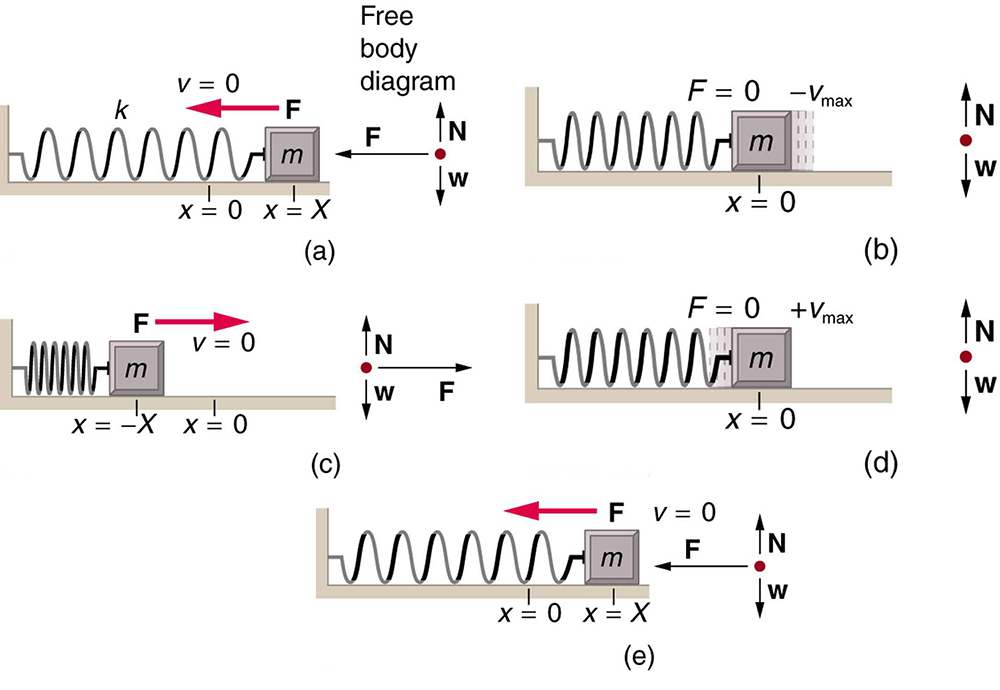
1.2 Mersenne’s Laws: The Fundamental Frequency
Mersenne’s Laws describe the frequency of a stretched string, and are crucial for the operation of stringed instruments like the piano (which is classified as percussion).
The equation for Mersenne’s Law is as follows:
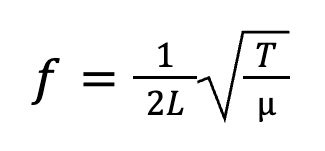
This equation discusses how tension (T), length (L), and linear mass density (μ) determine the fundamental frequency (f). Mersenne’s Laws consist of three laws of a vibrating string.
The Law of Length suggests that frequency is inversely proportional to the length of the string. For example, if we assume that other factors remain constant, doubling the length of the string will halve the frequency, which results in the pitch dropping by one octave. The Law of Tension states that frequency is directly proportional to the square root of the tension. Therefore, to double the frequency (play an octave higher), the tension has to be quadrupled.
This is the reason why turning the tuning peg of an instrument by a small amount results in smaller pitch changes, which allows finer control. Finally, the Law of Mass states that frequency is inversely proportional to the square root of the linear mass density (mass per unit length). For example, thicker strings vibrate at a slower rate than thinner strings when tension is constant. That’s why on instruments like the cello, the strings get noticeably thicker as the pitch decreases while keeping tension the same.
1.3 Standing Waves
On a string that is fixed at both ends, the length of the string (L) constrains the possible wavelengths. When both ends are fixed, they must be nodes (points of zero displacement).
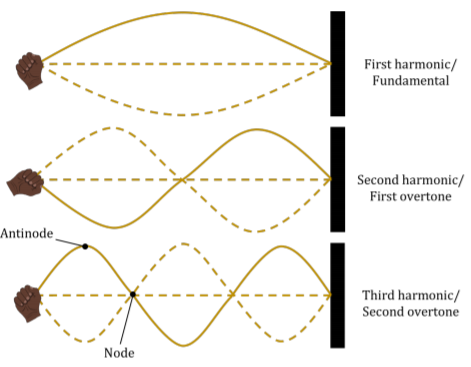
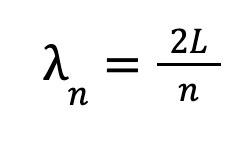
The first harmonic is the simplest way a string can vibrate. The general formula for the nth harmonic can be expressed as follows:
2. Initiation Mechanisms: The Use of Kinetic Energy
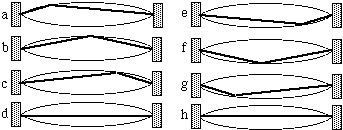
Plucking (pizzicato) applies a force on the string that displaces it from its equilibrium position. However, due to the sudden change of displacement, the string doesn’t oscillate yet. Instead, we can consider the string to be composed of two linear segments, and it is a triangular shape. In context, the peak of the triangle is the point of contact, resulting in the store of potential energy within the string’s tension, which is transferred to kinetic energy as it is released. When the string is released, the string with respect to the peak oscillates in opposite directions to the fixed ends. The sound dies down really quickly, however, as the high frequency components of motion (i.e. the peak of the triangle) disappear quickly.
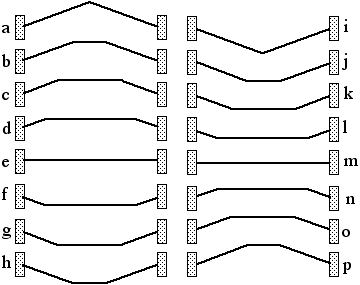
When a string is bowed, the source of energy is continuous, hence the same motion can be maintained.
3. The Use of the Bridge: Mechanical Impedance
Mechanical Impedance is the measure of how much a structure resists motion when subjected to a harmonic force. For example, a steel string has high impedance, as a strong force applied would have a low displacement, while a gut string (used during the Baroque period) has low impedance. This is because steel strings have much more tension compared to gut strings.
The equation for Mechanical Impedance is as follows:
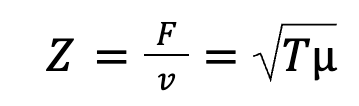
Where Z is the mechanical impedance (kgs-1), F & T is the tension (N), μ is the linear mass density (Kg/m), and 𝑣 is the wave speed (m/s).
As the air has a low-impedance medium, a low force, but a large displacement of molecules is needed to produce sound. That’s why a bridge is crucial; it disseminates the energy of the string across the soundboard, and without one, all the energy would reflect, creating barely any sound. Impedance matching is crucial to control how much an instrument resonates. A perfect match is formed when the bridge and the soundboard have the same impedance as the string, which causes the string to transfer all its energy.
4. Acoustic Radiation
A stringed instrument needs to amplify its sound through the body, which involves two types of resonance.
4.1 Helmholtz Resonance
The fundamental frequency is also referred to as Helmholtz resonance. In the case of stringed instruments, the volume of air within the instrument itself acts as a resonator and is forced into and out of the holes on the soundboard. The air around the holes acts as a concentrated “mass”, and the air inside the instrument itself acts as a spring. The soundboard moves inward, compressing the internal air, causing the air to move outwards. This creates a specific resonant frequency where air oscillates most efficiently. Luthiers (instrument makers) take in count the Helmholtz resonance. The smaller the sound holes or the larger the volume, the lower the frequency.
4.2 Structural Resonance
The wooden soundboards of stringed instruments have their own natural frequencies. If a string vibrates at a frequency that mismatches the natural frequency of the wood, the wood isn’t able to vibrate with a high amplitude. Luthiers use Chladni's Method to visualise where the nodal lines on a soundboard are. These are areas with zero displacement, while antinodes are areas of the wood with maximum displacement, and are responsible for pushing the air out and creating sound. The resonant frequencies of the wood can be found by using Young’s Modulus.
The relationship between the speed of sound (c), Young’s Modulus (E), and density (𝜌) can be found using this equation:
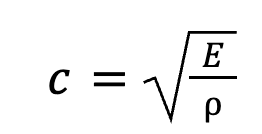
For example, an ideal material for a soundboard would have a high Young’s Modulus, but a low density, which results in a high speed of sound within the wood.
Conclusion
The physics involved in stringed instruments is highly complex and is ruled by the principles of acoustics and energy transfers. Luthiers go through tiring processes such as the application of Chladni’s Method to maximise the elegance an instrument could possibly produce while also having to take into account the frequencies of the soundboard and the strings. In this sense, instruments have not only been a matter of musicianship, but also a crucial part in determining areas of physics such as Young's Modulus.
Bibliography
- courses.lumenlearning.com. (n.d.). Simple Harmonic Motion: A Special Periodic Motion | Physics. [online] Available at: https://courses.lumenlearning.com/suny-physics/chapter/16-3-simple-harmonic-motion-a-special-periodic-motion/.
- Weisstein, E.W. (2007). Mersenne’s Laws – from Eric Weisstein’s World of Physics. [online] scienceworld.wolfram.com. Available at: https://scienceworld.wolfram.com/physics/MersennesLaws.html.
- Wolfe, J. (2006). Strings, standing waves and harmonics. [online] www.phys.unsw.edu.au. Available at: https://www.phys.unsw.edu.au/jw/strings.html.
- Rit.edu. (2026). Available at: http://spiff.rit.edu/classes/phys283/lectures/impedance/impedance.html [Accessed 7 Mar. 2026].
- Forinash, K. and Christian, W. (2020). 10.3.4: Volume or Helmholtz Resonance. [online] Physics LibreTexts. Available at: https://phys.libretexts.org/Bookshelves/Waves_and_Acoustics/Sound_-_An_Interactive_eBook_(Forinash_and_Christian)/10%3A_Strings/10.03%3A_Vibrating_Plates_Simulation/10.3.04%3A_Volume_or_Helmholtz_Resonance [Accessed 7 Mar. 2026].
- Experiment 1 DETERMINATION OF YOUNG’S MODULUS BY THE RESONANCE METHOD. (n.d.). Available at: https://pg.edu.pl/files/ftims/2021-03/SKRYPT01.pdf.