Red Light, Green Light: Game Theory in Traffic Networks

Traffic systems are game-theoretic systems systems. Multiple players - primarily the drivers and control systems - make strategic decisions in which individual outcomes depend on others’ choices. Game theory provides a mathematical framework for analysing these structures and relationships, through the concepts of players, strategies and payoffs. This framework applies across different aspects of traffic: intersection control, which involves optimising signal timing to satisfy competing demands, and network routing, to name a few.
Game Theory Foundations
Game theory studies situations in which the outcome depends on the actions of several players whose interests are interrelated. A game is defined as a set of players, the strategies available to them, and the payoffs that arise from different strategy combinations. The defining aspect of a game is strategic interdependence: the best action for one player depends on what others do.
One of the most important ideas in game theory is the Nash equilibrium, which is a strategy profile in which no player can improve their payoff by changing their strategy while the strategies of the other players remain the same. At equilibrium, each player is acting as best they can, given the actions of the other players. This leads to a stable outcome, but not necessarily an optimal one.
The difference between stability and optimality is important. Optimization for the individual can lead to a worse outcome for all. Traffic networks are a natural example of this, where each driver chooses the route that minimises their commuting time, but the traffic pattern that emerges may be congested or inefficient.
Game theory thus offers a way of understanding how rational behaviour aggregates into macroscopic patterns. It changes the point of view from individual behaviour to the structure of interaction, which becomes important when studying traffic networks.
Traffic Lights as Strategic Games
We can describe an intersection using just a few simple quantities. Let represent the number of cars waiting on road i. Over one signal cycle, the queue changes in a very natural way:
$$q_{i, \text{new}} = q_{i, \text{old}} + \text{arrivals}_i - \text{departures}_i$$
Arrivals are uncertain - cars do not come at perfectly regular intervals - while departures depend on how much green time the road receives. If we let denote the fraction of green time given to road i, then more green time means more cars can leave, and the queue tends to shrink. Less green time means the queue grows.
The key constraint is simple: $$g_1 + g_2 = 1$$, meaning the total green time is fixed. Giving more time to one road automatically takes time away from the other.
Each road would like to keep its average queue as small as possible, yet must do so within a shared constraint - no approach can improve its outcome without affecting others. If road 1 increases $g_1$, its queue falls, but road 2’s queue rises. The allocation of green time therefore cannot be chosen independently by any single road. Instead, it must settle at a split where each road’s share is optimal given the other’s share. At this point, no road can reduce its own queue by unilaterally adjusting its share of green time. This is the Nash equilibrium for the signal allocation.
What makes this so powerful is that the balance shifts naturally with traffic conditions. If one road receives heavier traffic, the stable split moves toward giving it more green time. When both roads are equally busy, the green time is shared more evenly. Rather than imposing a rigid schedule, the signal timing reflects a dynamic compromise shaped by demand. This system has already been implemented as the SCOOT control system, which stands for Split Cycle Offset Optimisation Technique. Studies have found it provides roughly a 12% reduction in delay and about an 8% reduction in stops for traffic. Out of the roughly 6,000 traffic signals that London has, around 2,000 currently operate on SCOOT control.

Dietrich Braess’s Paradox
In 2003, Seoul demolished the Cheonggyecheon Expressway, which was a 10-lane roadway and a 4-lane elevated highway that ran through the centre of the city. It carried over 170,000 vehicles daily, and after it was demolished it was replaced with a river which is now the Cheonggyecheon stream. Counterintuitively, traffic improved. Vehicle volumes were redistributed across the network, and overall traffic flow stabilised. This is a result of Braess's paradox: in 1968, Dietrich Braess proved that adding a new road to a network can increase total travel time at equilibrium, not because drivers behave irrationally, but because they behave rationally.
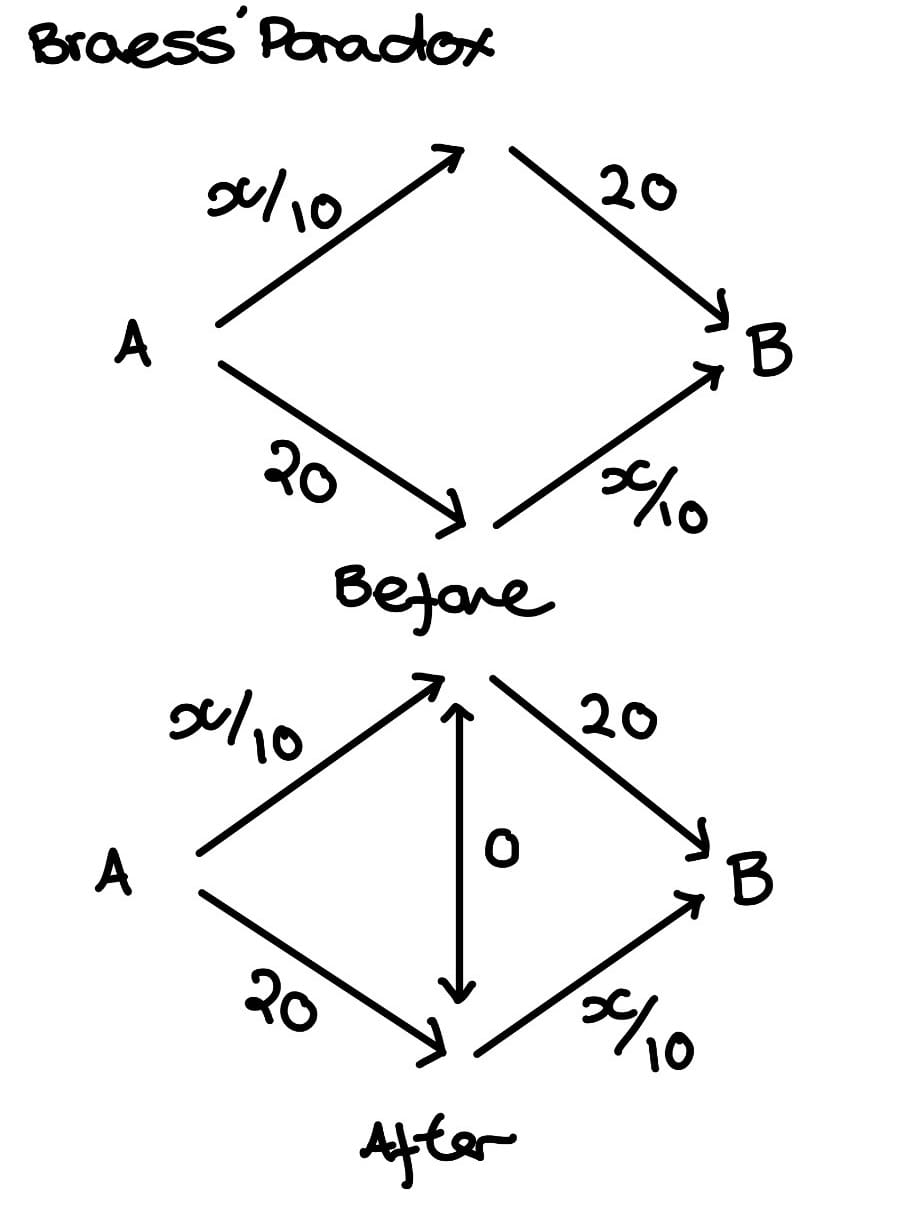
The best way to imagine Braess’s paradox is with a simple hypothetical road network. When travelling from point A to point B, two routes can be taken: both pass through a large road, where the time to travel takes 20 minutes regardless of the volume of cars, and a small road, where the time taken is equal to the number of cars divided by 10 (minutes). Suppose there are 200 drivers. In equilibrium, traffic splits evenly across the two routes, since any imbalance would make one route strictly faster and attract drivers. If the drivers split evenly, then each small road carries 100 cars, so the small-road travel time is \frac{100}{10} = 10 minutes. Each route therefore takes 20 + 10 = 30 minutes.
Now suppose we add a shortcut between the two routes that takes effectively 0 minutes to traverse. Since the small road with 200 cars would take \frac{200}{10} = 20 minutes, any driver can improve their own travel time by using the small road, the shortcut, then the second small road. If all drivers do this, each small road now carries 200 cars and takes 20 minutes, so the total time becomes 20 + 0 + 20 = 40 minutes. This is a Nash equilibrium (no single driver can improve their time by switching), yet it is worse for everyone than the previous arrangement. The new road has made all drivers slower.
Braess’s paradox reveals a fundamental insight: more capacity does not always mean better performance. What matters is how rational players interact within the network. Although this can sound like an artificial example, researchers have found real-world instances where removing a road improves performance - examples have been studied in cities such as New York, Boston, and other major urban areas.
Conclusion
Traffic systems demonstrate important lessons in game theory: when people act alone, the overall outcome may be unexpected. When many rational players interact with each other, there are behaviours that cannot be explained by examining a single agent in isolation. Game theory is a tool that helps explain this. It helps us recognise roads, traffic signals, and routes not only as engineering structures but also as parts of a strategic system. The operation of the system depends as much - if not more - on incentives and interactions than on design alone.
Looking ahead, game theory will become even more important with the development of connected and autonomous vehicles. Driving is a strategic activity, and many decisions consist of predicting the actions of other players. As more autonomous vehicles are introduced, the way they coordinate and make decisions will become as important as sensors and control algorithms. By incorporating game theory into connected traffic systems, vehicles could coordinate their manoeuvres, decrease congestion, and minimise harmful externalities such as delays.

![Image via [Adobe Stock]](/content/images/size/w600/2026/03/IMG_0874.jpeg)