Gyroscopic Principles and Its Practical Technologies
Introduction: Brennan’s Gyroscopic Monorail
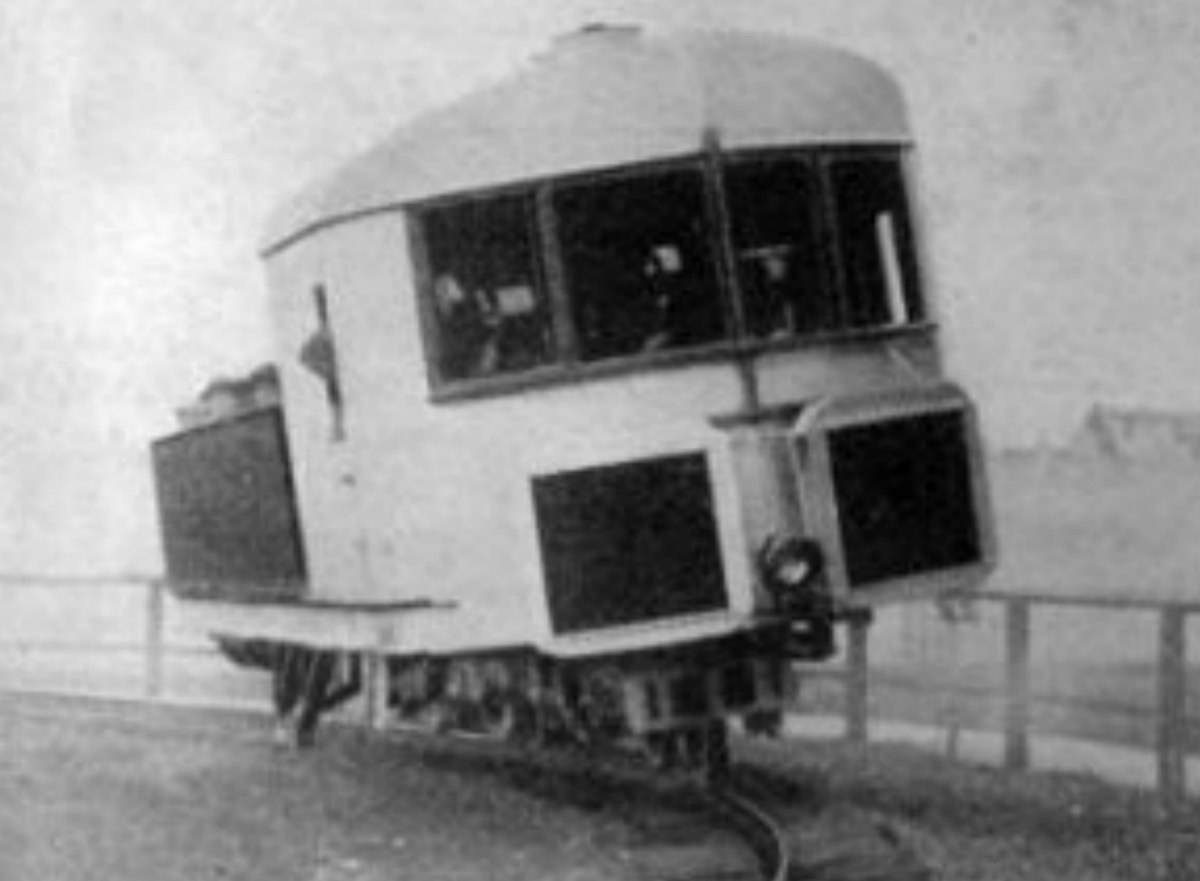
In 1910, at the Japan-British exhibition, Irish Australian mechanical engineer Louis Brennan unveiled a monorail that could balance dangerously on a singular rail with inline wheels. This 22-ton machine, even when stationary, did not tip over, and could carry up to 50 people around a mile long circuit per trip. One of these passengers was a 35-year-old Winston Churchill, who at the time was the Home Secretary, who after even driving the train one round, was so enthralled by the machine, that he took the Prime Minister (H.H. Asquith) among other Liberal Democrat party members to see it the following week. The train was even awarded the grand prize of the exhibition.
But how exactly did Brennan’s monorail stay upright? At first glance it looks like if its passengers were not perfectly distributed, then the train would tip over. However, the key to this engineering marvel is actually 2 gyroscopes with a combined weight of 1.5 tons spinning at 3000 revolutions a minute. These gyroscopes use the principle of the conservation of angular momentum to make Brennan’s train incredibly stable, even when it leans into turns, due to something called gyroscopic precession. The physics of gyroscopes mean that they are great for maintaining or changing orientation.
The Physics of Gyroscopes: Angular Momentum and Torque
To understand how gyroscopes work, we can look at a simpler example of one; a spinning top. When it isn’t spinning, it acts as we expect and falls over, due to gravity pulling its centre of mass down. This is called a torque, as the top’s centre of mass has moved outside its base of support, so there is a perpendicular distance between the centre of mass and the base which acts as a pivot. Therefore, there is a moment due to the force of gravity, and a turning force of torque causes the stationary top to fall over.
This torque still applies to the top when the top is spinning. This time, though, the spinning top can stay balanced as long as it's spinning. This is because rotating objects have something called angular momentum. Like its linear counterpart, angular momentum in a system is conserved, unless an external torque acts upon it. When you spin a top, angular momentum acts in the direction of rotation. Torque is also a vector and acts perpendicular to angular momentum.
Gyroscopic Precession
As a visual aid, imagine the moon orbiting the earth. It too has angular momentum. If you were to supply a force straight down on it, its orbit wouldn’t shift down, due to it already having a velocity vector that causes it to orbit. The two vectors would combine, and its new orbital path would be the vector sum. Crucially, if we looked at the shape of the orbit, instead of rotating its path at the point the force is acting, which is what happens with a stationary top, the tilt occurs 90 degrees ahead in the orbital path form where the force acted. This also applies to a gyroscope, as each of the gyroscope's component parts are connected, the gyroscope's tilt will be the same as the change in the moon's flight path.
This can also explain why the dip in a spinning top seems to move around. As the gyroscope begins to tilt, the direction of torque shifts to that direction, but then the tilt is felt 90 degrees along the path as well, so the gyroscope precesses.
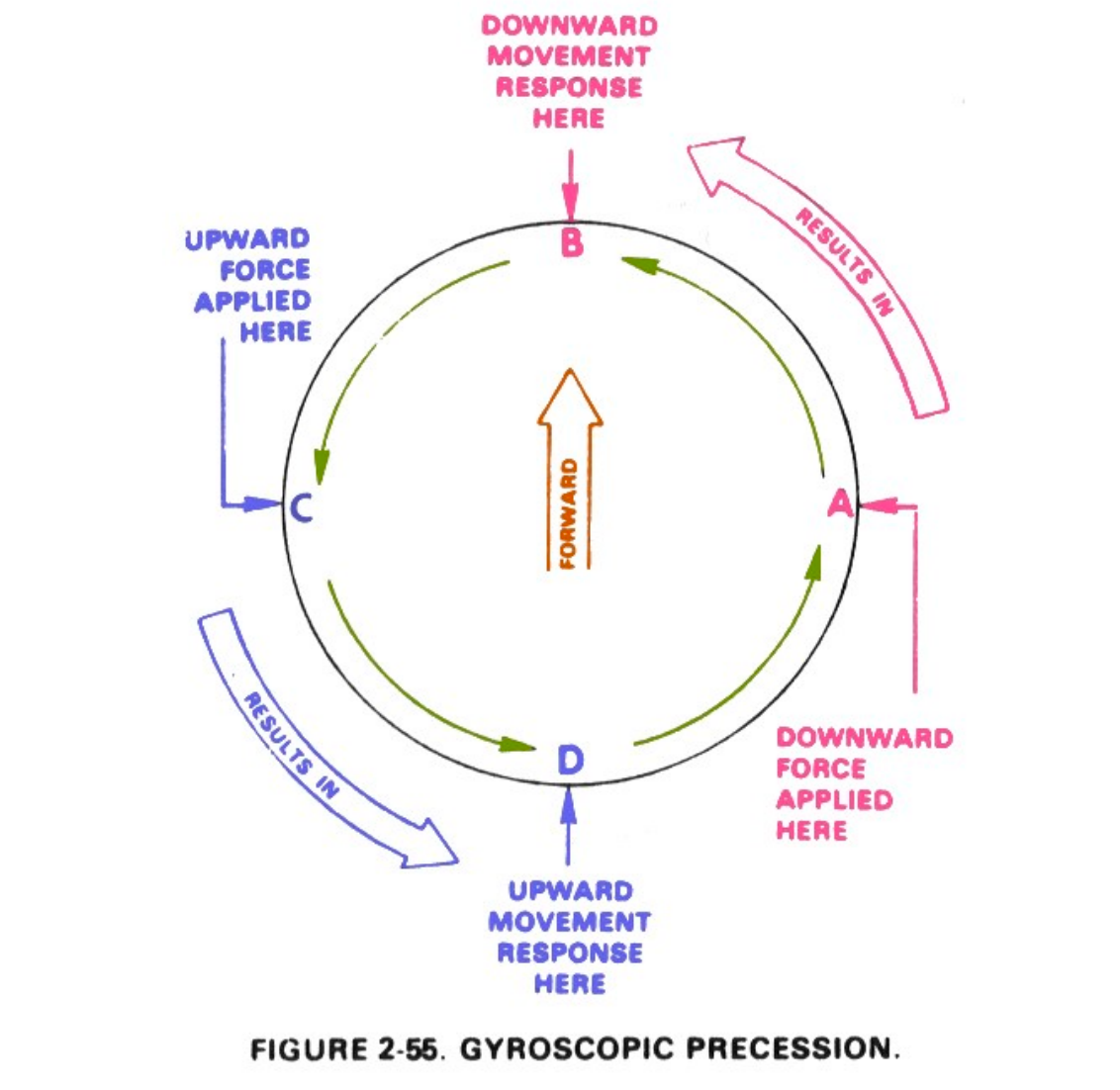
Now we can understand how Brennan’s gyrorail could stay upright. If a torque (i.e. from gravity) causes the train to begin to fall over, the two gyroscopes cause the train to precess and produce a torque that would lift the train back up. At that scale, the train wouldn’t even shift noticeably. The two gyroscopes also spin in opposite directions, so when they precess due to a gravitational torque, the train doesn’t rotate around the axis of the track as their angular momentums cancel each other out so the vehicle remains stable without twisting.
Quantifying Stability: Moment of Inertia and Angular Momentum
Therefore, we now understand why a spinning object is so stable, due to its angular momentum and gyroscopic precession. Somewhat intuitively, the higher an object's angular momentum, the more torque required to change its motion, meaning greater stability. The formula for angular momentum is L = Iω, with ω being angular velocity measured in radians per second, and I being moment of inertia. An object's moment of inertia is the ratio between the torque applied to an object and its angular acceleration, calculated as I= Σ mir squared i, meaning it depends not only on the mass of an object, but how far away from the axis of rotation the mass is distributed. Essentially, increasing the inertia or velocity of a gyroscope also increases its stability.
Practical Applications of Gyroscopes
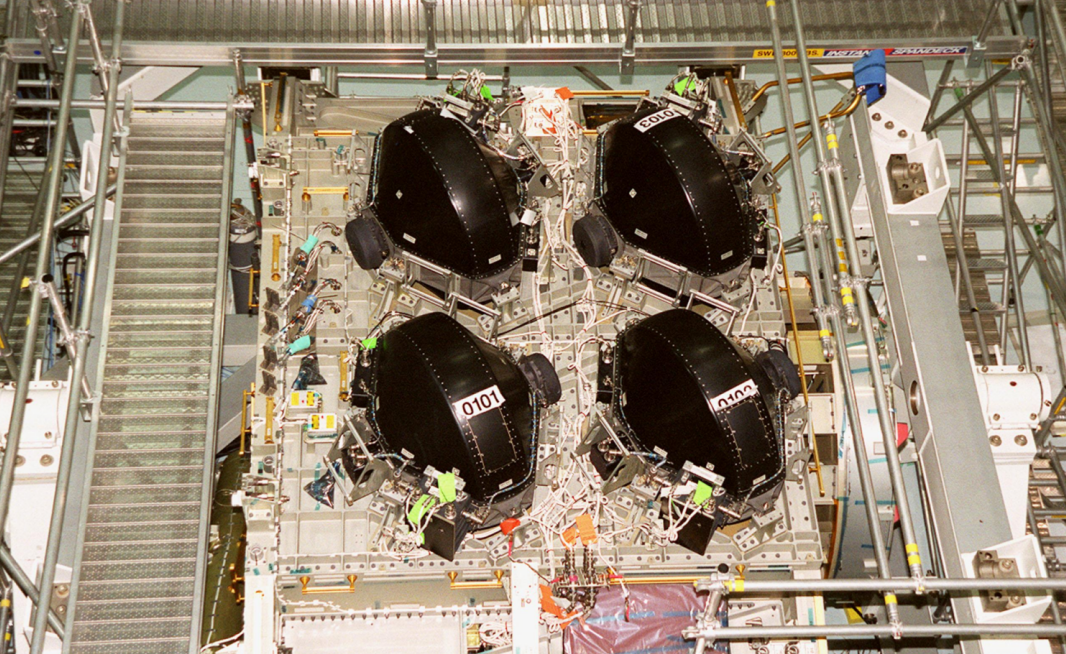
Some other uses for mechanical gyroscopes are ship stabilisers, as, just like with the gyro monorail, they can counter a ship's roll. However, they have fallen out of use to ship stabilising fins due to the produced moment being insufficient if wave height is too high. Even so, ship stabilising fins still use gyroscopes, as gyroscopic control systems are used to detect changes in orientation and then accordingly change the fins’ angle of attack. Another example is in satellites. The International Space Station has 4 gyroscopes spinning at over 6000 revolutions per minute, which are either used to maintain orientation, or are rotated to produce a gyroscopic force to change the attitude of the ISS.
Bibliography
"Gyro Monorail." Wikipedia, the Free Encyclopedia, Wikimedia Foundation, Inc, 7 Feb. 2026, en.wikipedia.org/wiki/Gyro_monorail. Accessed 22 Feb. 2026.
"Gyroscope." Wikipedia, the Free Encyclopedia, Wikimedia Foundation, Inc, 16 Feb. 2026, en.wikipedia.org/wiki/Gyroscope. Accessed 22 Feb. 2026.
"Angular Momentum | Definition, Examples, Unit, & Facts | Britannica." Encyclopedia Britannica, 17 Feb. 2026, www.britannica.com/science/angular-momentum.
![Image via [Adobe Stock]](/content/images/size/w600/2026/03/IMG_0874.jpeg)