Disease as a threat on endangered species
Disease has only accounted for the extinctions of less than 4% of known species since 1500, and only affects around 8% of species now listed as critically endangered, according to National Institute of Health studies. While it lacks a major role in the overall force of extinction for species around the world, disease is one of the biggest threats for animals in a local scale, especially in specific taxa. Disease also acts as a final ‘punisher’ to animals already nearing the brink of extinction
The causes of disease in endangered animals
There are many new and dangerous causes to the increased rate of disease and disease related deaths of animals. The overlapping main causes are the movement of pathogens across the world by humans and the proximity effect, where animals are forced to live closer to each other and to other species, including humans. This not only increases the risk of disease being transmitted in all forms like air and vectors, but in the long term, decreases genetic diversity which makes the population itself more susceptible to disease. The driving force of this proximity effect is the increased human wildlife overlap of today and the fragmentation and destruction of animals’ habitats. Another driver of disease that will most likely affect wildlife even more in the future is climate change as a higher overall temperature gives more favourable conditions to new and so dangerous viruses and other pathogens in new areas that weren’t previously affected. Some examples of the diseases affecting wildlife the most include: Fibropapillomatosis, Chytrid Fungus, Chronic Wasting Disease, and Sea star wasting disease.
The effect of human-wildlife overlap
Human wildlife overlap is very dangerous to wildlife and to humans alike. As well as zoonotic diseases, which go from other animals to humans, there are anti-zoonotic diseases which go the other way. Diseases such as, for example, Ebola in many parts of western and central Africa, especially, can be passed on to animals like in this case, gorillas, chimpanzees and other apes, and with ever expanding human settlements infringing more and more on natural habitats, more animals receive diseases transmitted to them by humans. Humans additionally bring disease to animals through our ever-expanding trade and transport systems around the world. We now have the capability to bring any virus, bacteria or other pathogen to any part of the globe whether through direct transmission or by bringing any objects or living beings carrying pathogens. Furthermore, we may worsen these pathogens for other species ourselves, by providing animals raised for food with antibiotics and using antibiotics ourselves. These drug-resistant pathogen strains are more able to affect wildlife populations as well. Another part of human-wildlife overlap is conflict. Many farmers will use guard animals like dogs to protect crops and livestock from attackers. This already has its own consequences in that dogs will injure and even kill wild animals, and additionally, they may infect these animals with diseases. In India, guard dogs often transmit Canine Distemper Virus (CDV) to wild felids. A 2022 study showed that 22 out of 129 (17.05%) wild felids in India tested positive for CDV. The disease causes fatal neurological consequences and kills many felids and with such a large infected population, it is a major threat to Indian wildlife.
The Most Threatening Wildlife Diseases
Fibropapillomatosis:
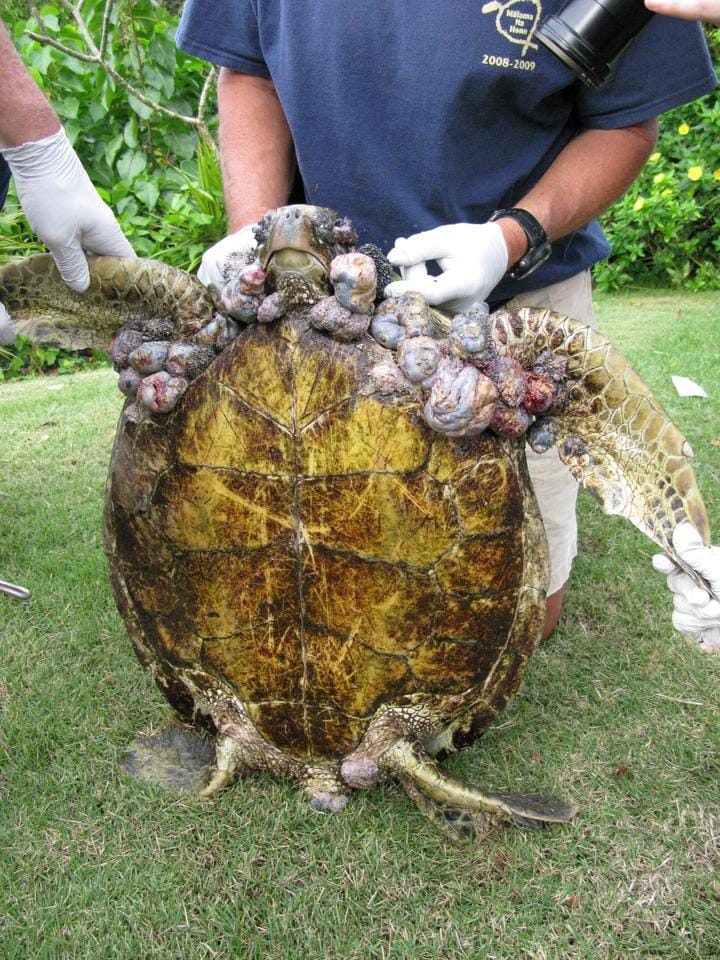
Fibropapillomatosis (FP) is a viral disease seen in turtles. It causes tumours on the turtles’ bodies, in their eyes and mouths, and on internal organs. Often fatal, it is seen to affect green turtles, and it severely damages navigation, feeding and survival. We do not know how the virus is transmitted, but it is linked to increasing environmental degradation in areas where it affects more turtles. In areas largely untouched by humans, like the good grazing areas off the coast of West Africa, disease levels are moderate in green turtles, at 33% in Guinea-Bissau and 28% in Mauritania, using data collected from turtles captured there in 2018-2019. However, in more densely populated areas like Puerto Rico, populations affected by FP are higher. At Puerto Manglar in 2003, 79% were infected with FP.
Chytrid Fungus
Chytrid fungus is a fungal disease that affects amphibians. It starts as a skin infection and later causes heart failure in frogs. The species of fungus that cause this disease are native to South America but have been introduced to the rest of the world through human trade of amphibians. They have driven at least 501 amphibian species to decline and led to at least 90 being extinct.
Chronic Wasting Disease:
This is a neurological prion disease with no known cure. It is found in areas of North America, Norway and South Korea. The disease affects deer, elk, reindeer and moose, and has a 100% fatality rate. Between 1988 and 2006, deer abundance declined by 45% due to the disease.
Conclusion:
Disease remains a large factor to look out for in relation to the endangerment of species worldwide. Although not being as much as a large scale, urgent problem as things like climate change and habitat destruction, disease can be devastating on smaller and more specific scales. In the future, to combat the imbalance of disease on animals and plants of today, we must protect the environment from climate change, global warming, human wildlife conflict and the other causes of extinction as they are almost always proportional to the increase in disease rates we see now.
Bibliography:
- "Increased Threat of Disease As Species Move Towards Extinction." PMC Home, pmc.ncbi.nlm.nih.gov/articles/PMC4398030/.
- "How Habitat Fragmentation Affects Animals." IFAW, 2 Sept. 2025, www.ifaw.org/uk/journal/habitat-fragmentation-affects-animals.
- "Emerging Animal Parasitic Diseases: A Global Overview and Appropriate Strategies for Their Monitoring and Surveillance in Nigeria." PMC Home, pmc.ncbi.nlm.nih.gov/articles/PMC4200699/.
- W, Cam. "What Are Some of the Most Threatening Wildlife Diseases?" Think Wildlife Foundation | Let's Preserve Our Planet's Biodiversity, 14 Nov. 2022, thinkwildlifefoundation.com/what-are-some-of-the-most-threatening-wildlife-diseases/.
- Rahul Ganpatrao Kadam a b, M. Karikalan a, Chandra Mohan Siddappa a, K. Mahendran a, Gaurav Srivastava c, K.K. Rajak a, Yogesh Bhardwaj d, Rajat Varshney a b, Zahoor Ahemad War a, Rahul Singh a e, Mayukh Ghosh b, V. Beena a, Abhijit M. Pawde a, K.P. Singh a, A.K. Sharma a “Molecular and pathological screening of canine distemper virus in Asiatic lions, tigers, leopards, snow leopards, clouded leopards, leopard cats, jungle cats, civet cats, fishing cat, and jaguar of different states, India” www.sciencedirect.com/science/article/pii/S1567134822000089
- “Fibropapillomatosis and the Chelonid Alphaherpesvirus 5 in Green turtles from West Africa” PMC home, https://pmc.ncbi.nlm.nih.gov/articles/PMC8463353
- Wider Caribbean Sea Turtle Conservation Network (WIDECAST), www.widecast.org/What/AnnualMeeting/2019/2019%20Diez%20&%20Patricio,%20Insights%20into%20Green%20Turtle%20Fp,%20Puerto%20Rico.pdf.
![Image via [Adobe Stock]](/content/images/size/w600/2026/03/IMG_0874.jpeg)