Could animal organs be the answer?
1. The organ shortage: why do we need xenotransplantation?
Worldwide, the demand for organs vastly exceeds the supply available for transplantation. In the United States alone, according to data from the American Journal of Transplantation although 143,982 adults were listed for a kidney transplant in 2024, with 10.7% having already waited five years or more. Pre-transplant mortality has fallen from its pandemic-era peak, 4.7 kidney transplant candidates still died per 100 patient-years in 2024. The consequences of this shortage extend beyond death: some patients become too sick to receive a transplant at all, with a 2026 study finding that the risk of removal from the kidney waiting list because a candidate had become too sick increased by 25% in the period studied. Meanwhile, Nature Medicine reported in 2025 that approximately 12 people in the US die each day while waiting for a kidney. These figures reveal the fundamental problem facing transplantation: even when medicine can successfully replace a failing organ, there may simply not be a suitable human organ available in time. But what if the shortage of human donors could be reduced without relying solely on human donors? One increasingly serious possibility is xenotransplantation — the transplantation of cells, tissues or organs between different species.
2. What exactly is Xenotransplantation?
Xenotransplantation — the transplantation of living cells, tissues or organs between different species — is not a new idea. In 1906, French surgeon Mathieu Jaboulay attempted to transplant a pig kidney into a human patient, but the organ was rejected within days. More than a century later, the central problem remains the same: the human immune system recognises animal tissue as foreign and attacks it. Early experiments with pig organs were particularly unsuccessful because human antibodies could recognise molecules on the surface of pig cells, triggering complement activation and rapid destruction of the transplanted tissue. Even if this initial immune response could be controlled, another problem emerged: humans and pigs have differences in their blood-clotting systems and vascular biology, meaning that transplanted organs could suffer severe inflammation and damage to their blood vessels. For decades, these barriers made xenotransplantation little more than an experimental possibility. The development of advanced gene-editing techniques, however, has changed the problem. Scientists can now modify pigs before transplantation, removing genes that produce major immune targets, adding selected human genes and inactivating porcine retroviruses
3. How genetic engineering has changed xenotransplantation.
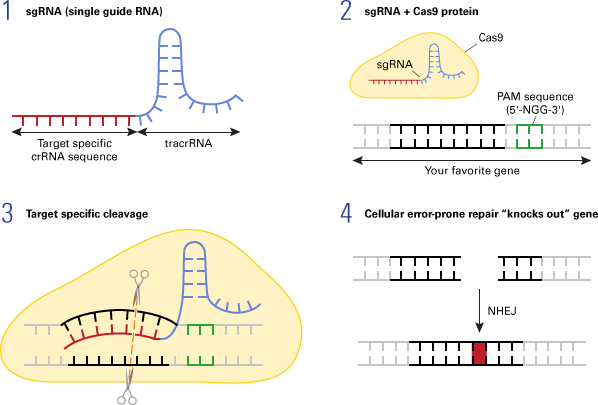
For xenotransplantation to become viable, scientists first had to overcome the biological incompatibilities between pigs and humans. The problem was not simply that the human immune system recognised pig organs as foreign; the resulting immune response could rapidly damage blood vessels and prevent the organ from functioning. Advances in genetic engineering have offered a potential solution. Using technologies such as CRISPR-Cas9, a gene-editing technology that enables scientists to make targeted changes to an organism's DNA. The system uses a guide molecule to locate a specific DNA sequence and an enzyme, Cas9, to cut the DNA at that location. Scientists can then disrupt selected genes or introduce genetic material to alter the organism's characteristics. This allows researchers to remove pig genes associated with immune rejection, introduce human genes intended to improve compatibility, and inactivate pig based viruses. The significance of this technology is illustrated by a pig kidney transplanted into a human in 2024, which contained 69 genomic edits. Nevertheless, genetic modification does not eliminate every complication: recipients still require immunosuppressive medication, and researchers must address risks including infection, vascular injury and long-term graft failure. Xenotransplantation has therefore progressed beyond the earlier problem of immediate rejection, but the challenge remains to produce organs that function safely and reliably over extended periods.
4. The Tim Andrew’s breakthrough.

The potential of these advances became particularly clear in the case of Tim Andrews, a patient with end-stage kidney disease who received a genetically modified pig kidney in January 2025. According to a 2026 report in the Lancet, the transplanted kidney enabled him to remain independent of dialysis for 271 days, representing a major milestone in living-human kidney xenotransplantation. However, the case also demonstrates why the technology should not yet be considered a replacement for conventional transplantation. Although the kidney initially functioned, the recipient experienced an episode of T-cell-mediated rejection, followed later by microvascular injury and thrombotic microangiopathy, ultimately necessitating removal of the organ. Andrews subsequently received a human kidney, making the case particularly significant because it demonstrated the possibility of using a pig organ before a conventional transplant. Rather than proving that genetically modified pig kidneys can provide a permanent solution, the study offers evidence that xenotransplantation might one day serve as a bridge for patients who cannot obtain a human organ quickly enough. The next challenge is to establish whether these results can be reproduced consistently, with fewer complications and substantially longer graft survival.
5. From experimental breakthrough to clinical treatment
Despite the progress demonstrated by recent transplants, xenotransplantation must undergo extensive clinical testing before it can become a routine treatment. A successful transplant in an individual patient does not necessarily demonstrate that the procedure is safe or effective for the wider population. Researchers must establish whether genetically modified pig organs can function reliably over several years, whether rejection can be controlled without dangerously suppressing the recipient's immune system, and whether complications such as vascular injury can be prevented. Formal clinical trials are therefore essential: they allow researchers to assess outcomes across multiple patients under controlled conditions, rather than drawing conclusions from isolated cases. In the United States, regulators have begun allowing carefully controlled clinical studies of genetically modified pig organs, marking a significant transition from experimental procedures towards structured medical research. However, progress will depend on more than demonstrating short-term kidney function. Researchers must also establish long-term graft survival, monitor patients for infections, determine appropriate immunosuppressive treatments and assess whether the procedure offers a meaningful advantage over dialysis or conventional transplantation. If these challenges can be overcome, xenotransplantation could eventually provide an additional source of organs for patients who might otherwise face prolonged waits. For now, however, its future depends on the results of clinical testing rather than the promise of the technology alone.
6. Xenotransplantation: risks and the future of organ donation
Ultimately, the future of xenotransplantation will depend on whether its remarkable scientific progress can be translated into safe, reliable and accessible treatment. Although genetically modified pig organs could offer a new source of transplants and potentially reduce dependence on human donors, significant challenges remain. The risks of immune rejection, vascular injury and animal-to-human infection must be carefully managed, while the ethical implications of breeding genetically modified animals for their organs require continued scrutiny. Furthermore, even if the technology proves successful, its cost and availability will influence how many patients can benefit from it. The experience of Tim Andrews demonstrates both the promise and the limitations of this approach: a pig kidney sustained him without dialysis for 271 days, yet its eventual failure showed that long-term success remains uncertain. Xenotransplantation is therefore not yet a replacement for conventional organ donation, but it may eventually complement it, potentially providing a temporary bridge to human transplantation or a longer-term alternative for selected patients. The ultimate measure of its success will not simply be whether scientists can transplant an animal organ into a human, but whether they can make that organ function safely for long enough to transform a patient's life.
Works Cited
David C K Coope, Richard N Pierson 3rd. "Milestones on the Path to Clinical Pig Organ Xenotransplantation." PubMed, 23 Mar. 2023, Accessed 8 Oct. 2026.
"In a First, Genetically Edited Pig Kidney Is Transplanted Into Human." Hms.harvard.edu, 21 Mar. 2024, hms.harvard.edu/news/first-genetically-edited-pig-kidney-transplanted-human. Accessed 8 Oct. 2026.
Katie Ross-driscoll, et al. "Association of a new waitlist mortality metric with likelihood of delisting among kidney transplant candidates." amjtransplant.org, 2026, www.amjtransplant.org/article/S1600-6135(26)00097-3/abstract. Accessed 8 Oct. 2026.
Kimberly Smith. "What Is CRISPR?" NIGMS National Institute of General Medical Sciences | National Institute of General Medical Sciences, 16 Oct. 2024, www.nigms.nih.gov/biobeat/2024/10/what-is-crispr. Accessed 8 Oct. 2026.
Krista lentine, et al. "OPTN/SRTR 2024 Annual Data Report: Kidney." amjtransplant.org, Elsevier Inc., 26 May 2026, www.amjtransplant.org/article/S1600-6135(26)00985-8/fulltext. Accessed 8 Oct. 2026.
Molly McDonough. "Xenotransplantation Enters a New Era." Harvard Medicine Magazine, 23 July 2026, magazine.hms.harvard.edu/articles/xenotransplantation-enters-new-era. Accessed 8 Oct. 2026.
Prof Leonardo V Riella, MD PhD, et al. "Porcine kidney xenotransplantation as a bridge to allotransplantation: a first-in-human study." thelancet, 2026, www.thelancet.com/journals/lancet/article/PIIS0140-6736(26)01295-X/abstract. Accessed 8 Oct. 2026.
Tatsuo Kawai, M.D., Ph.D., et al. "Xenotransplantation of a Porcine Kidney for End-Stage Kidney Disease." nejm, www.nejm.org/doi/10.1056/NEJMoa2412747. Accessed 8 Oct. 2026.
"A Tipping Point for Kidney Xenotransplantation." Nature, 14 July 2025, www.nature.com/articles/s41591-025-03855-9. Accessed 8 Oct. 2026.
"A tipping point for kidney xenotransplantation." Nature.com, Springer Nature, 14 July 2025, www.nature.com/articles/s41591-025-03855-9#citeas. Accessed 8 Oct. 2026.
"Xenotransplantation." U.S. Food and Drug Administration, 3 Mar. 2021, www.fda.gov/vaccines-blood-biologics/xenotransplantation. Accessed 8 Oct. 2026.